
How Many Laser Hair Removal Sessions Do You Need?
Why laser hair removal may take 2–8 or more sessions, how intervals vary and when reduction or maintenance may be assessed.
Laser Hair Removal Sessions
There is no universal session count. The American Academy of Dermatology says most patients need two to six treatments and can often be treated every four to six weeks, while Cleveland Clinic describes roughly six to eight treatments spaced six to eight weeks apart. Area, hair growth cycle, hair color and coarseness, skin tone, device, settings and hormonal influences can change both estimates.
Timeline at a glance
A package count is not a biological guarantee. Separate the first-session response, the scheduled series and later maintenance before comparing clinic offers.
Set a measurable baseline
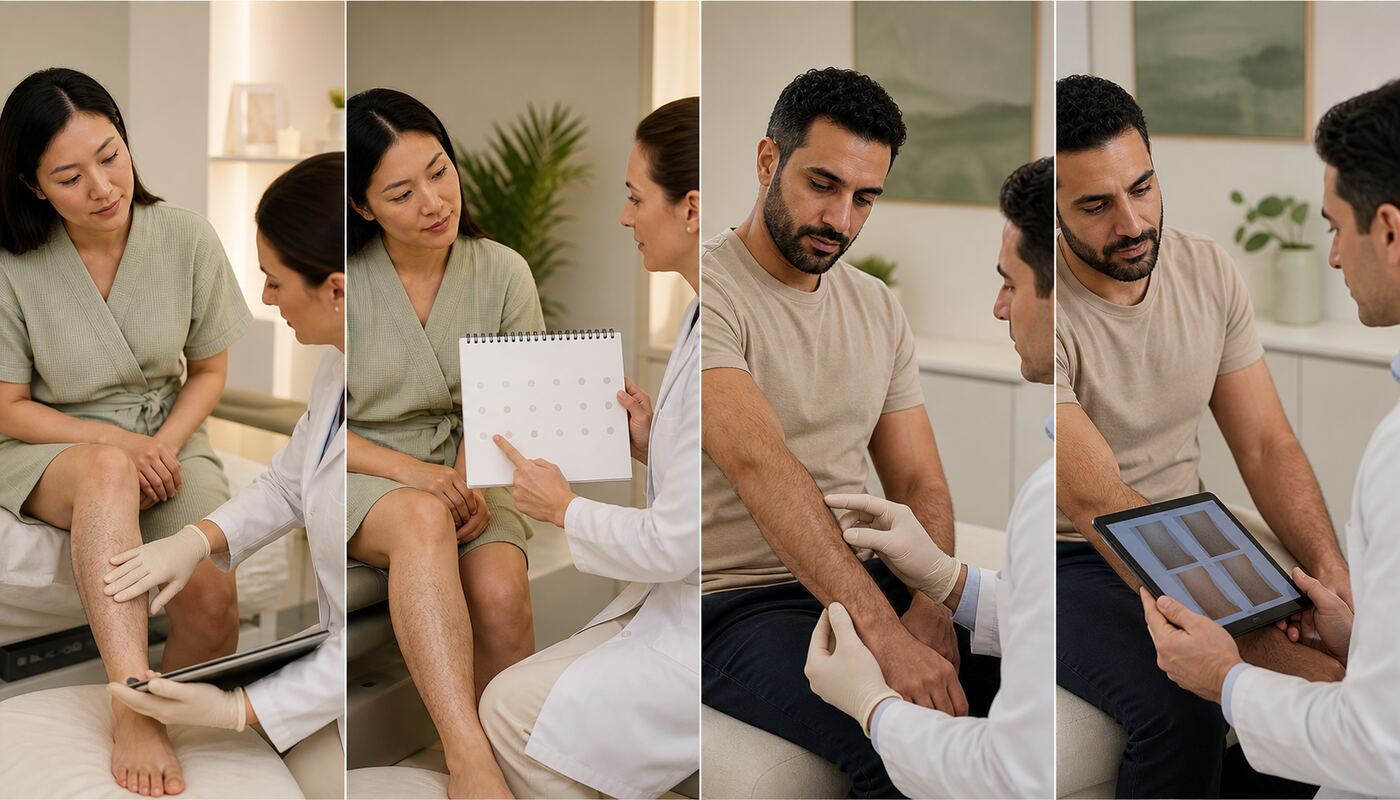
Record the treatment area, hair color and coarseness, skin tone, recent tanning, medicines, device and standardized photographs before estimating a series.
Early reduction may be visible
AAD and Cleveland Clinic cite an approximate 10% to 25% reduction after a first treatment, but an individual result can be outside that range and does not predict the whole series.
Sessions follow growth cycles
Published patient guidance gives different common intervals. The treating professional chooses timing for the area, response, skin and device rather than following one universal calendar.
Reassess reduction and maintenance
Hair-free periods may last months or years, but regrowth and maintenance treatment can occur. Remaining hair may be finer or lighter, and facial or hormonally influenced hair can behave differently.
The bars show relative visibility within this guide only. They are not percentages, clinical measurements or personal forecasts.
Why reputable sources give different session counts
Laser energy targets pigment associated with hair follicles, but only part of the hair population is in a responsive growth phase at one visit. Body area, hair density, color and coarseness, skin tone, hormonal influence and the exact light source change how much can be treated safely and how response is judged.
A count such as two to six or six to eight is therefore a patient-information range, not a promised package. The useful comparison identifies what counts as one session, which area is included, when progress is reviewed and what happens if the response is limited.
Deeper visual interpretation
Session estimates answer different questions depending on the source, body area and endpoint. Read the range as a planning input—not a coupon quantity or biological guarantee.
| Source context | Published planning range | Interpretation limit |
|---|---|---|
| AAD patient FAQ | Most patients: 2–6 treatments; often 4–6 weeks apart | The same page says individual response and safe retreatment timing vary |
| Cleveland Clinic patient guide | Often 6–8 treatments; roughly 6–8 weeks apart | An approximate care pathway, not a universal minimum or maximum |
| Clinic package | A commercial number chosen by the seller | Does not prove the area, device, interval, maintenance or expected reduction |
Compare a series without misleading photos
- Fix the body area
Do not compare a half-leg quote with a full-leg session or combine face and neck without stating both.
- Fix the shaving interval
Photograph at the same time after shaving; different stubble length can dominate the visual comparison.
- Record every session
Keep date, device, area, test spot, broad setting record supplied by the clinic, reaction and next planned review together.
- Separate maintenance
Ask whether later visits are expected, included, discounted or treated as a new package.
How to interpret the stages
A recovery timeline combines broad observations from published patient guidance. It cannot know the exact product or device, treatment depth, technique, medical history, skin characteristics or aftercare plan involved in one person’s case.
Use the stages to understand the order in which changes may happen and to prepare questions for a qualified professional. Do not use a general internet timeline to override instructions from the clinician who assessed and treated you.
Aftercare principles
- Compare clinic estimates only after confirming the same body area, device type and definition of a session.
- Use photographs with the same shaving interval, lighting, distance and angle; stubble length can mimic improvement or regrowth.
- Tell the provider about recent tanning, scarring or keloids, cold sores, isotretinoin and all other medicines.
- Ask how the operator’s experience with your skin coloring changes device choice, settings and test-area planning.
- Do not prepay for a large series without understanding refund, expiry, maintenance and complication policies.
Laser hair removal can cause burns, blistering, infection, scarring and temporary or permanent pigment change. Seek prompt assessment for severe or increasing pain, blisters, spreading redness, pus, fever or marked darkening or lightening; do not wait for the next scheduled session.
Why your timeline may differ
Questions to ask before treatment
- What exact area and device does the session quote include?
- Why is this interval appropriate for the area and my hair-growth pattern?
- How will baseline, shedding, regrowth and reduction be photographed consistently?
- What response triggers a settings review, test area or different method?
- Are maintenance visits included, and when does a prepaid package expire?
- Who evaluates burns or pigment change between scheduled sessions?
‘Permanent hair removal’ and ‘permanent hair reduction’ may be regulated or marketed differently across jurisdictions and devices. Ask for the exact authorized claim in the treatment country, and keep the contract, device name and session record if treatment continues elsewhere.
Find official checks for 12 marketsHow this guide was made
3 named sources support the main claims. Each link explains how it was used, with public agencies, professional bodies or primary research preferred.
AI may assist with research organization, drafting and translation, but it is not treated as a source or credential. Read the editorial standards.
Stage bars organize a relative sequence. Original editorial illustrations are conceptual and are not clinical measurements, outcome percentages or personal forecasts.
This version has editorial evidence review, not medical review attributed to a named clinician. It does not replace an individual assessment. Editorial accountability.
Sources
- American Academy of Dermatology: Laser Hair Removal FAQs
First-treatment reduction, common treatment count, four-to-six-week intervals, duration, maintenance and risks.
- Cleveland Clinic: Laser Hair Removal
Growth-cycle rationale, six-to-eight-treatment estimate, spacing, permanence limits and safety context.
- Leeds Teaching Hospitals NHS Trust: Laser Hair Reduction
Test-area assessment, hair-color limits, realistic reduction expectations and inability to predict duration for every person.
Frequently asked questions
What should I know about Laser Hair Removal Sessions?
There is no universal session count. The American Academy of Dermatology says most patients need two to six treatments and can often be treated every four to six weeks, while Cleveland Clinic describes roughly six to eight treatments spaced six to eight weeks apart. Area, hair growth cycle, hair color and coarseness, skin tone, device, settings and hormonal influences can change both estimates.
Why can the timeline differ from person to person?
Treatment type, depth, technique, anatomy, skin and tissue response, health history, medication, aftercare and complications can all change timing. The treating professional’s instructions take priority over a general guide.
When should I contact a professional?
Laser hair removal can cause burns, blistering, infection, scarring and temporary or permanent pigment change. Seek prompt assessment for severe or increasing pain, blisters, spreading redness, pus, fever or marked darkening or lightening; do not wait for the next scheduled session.
Read the laser hair removal aftercare guide
Separate the one-to-three-day surface response from sun protection, device safety, warning signs and the longer result clock.
Open companion guideExplore the complete laser hair removal guide
Connect session ranges, intervals, aftercare, skin tone, exact-device checks, maintenance and warning signs without mixing their timelines.
Open laser hair removal topic hubRelated beauty guides
View Hair & RemovalLaser Hair Removal Aftercare and Results Timeline
Laser hair removal aftercare for redness, swelling, sun exposure, skin-tone safety and results across multiple sessions.
Read next HAIRHair Transplant Recovery Timeline: Shedding to New Growth
A timeline for washing, stitches, temporary shedding, return to activity and early new growth after hair transplantation.
Read next HAIRMounjaro Hair Loss: Evidence, Shedding Timeline and What to Check
What current Mounjaro and tirzepatide labels say about hair loss, how shedding differs from other patterns, and what to document before treatment decisions.
Read nextThis guide is for general education only. It is not medical advice, diagnosis, a treatment recommendation or a prediction of individual results. BeautiNext is not a clinic. Seek care from an appropriately qualified professional.