
Can You Use Niacinamide and Retinol Together?
How niacinamide and retinol can fit in one routine, what combination studies actually show and why irritation still needs its own plan.
Niacinamide and Retinol Together
Niacinamide and retinol can appear in the same skincare regimen, including in products formulated with both. That does not prove that every two separate serums should be layered in one application or that niacinamide will prevent retinol irritation. Introduce one product at a time, follow the exact retinoid instructions and use a stable moisturizer and daytime sunscreen. If using two separate formulas together is uncomfortable or hard to interpret, separate them by morning and night or alternate nights.
A routine sequence at a glance
The useful sequence is not a promise that one ingredient will cancel the other’s side effects. It keeps product identity, introduction and irritation troubleshooting separate.
Name the exact retinoid
Retinol, retinal, adapalene and prescription tretinoin are not interchangeable. The label or prescription determines frequency, amount and timing.
Add one formula
Test and introduce only one new product while cleanser, moisturizer and sunscreen stay stable. This makes a reaction easier to attribute.
Choose one simple pattern
Use a deliberately co-formulated product as labeled, layer separate products only if their instructions and tolerance support it, or separate niacinamide and retinol across routines.
Judge tolerance directly
Burning, widespread redness, rash or persistent peeling is not evidence that niacinamide is buffering the retinoid. Reduce complexity and seek advice when symptoms are significant.
The bars organize decision priority within this guide. They are not ingredient-strength scores, clinical measurements or result forecasts.
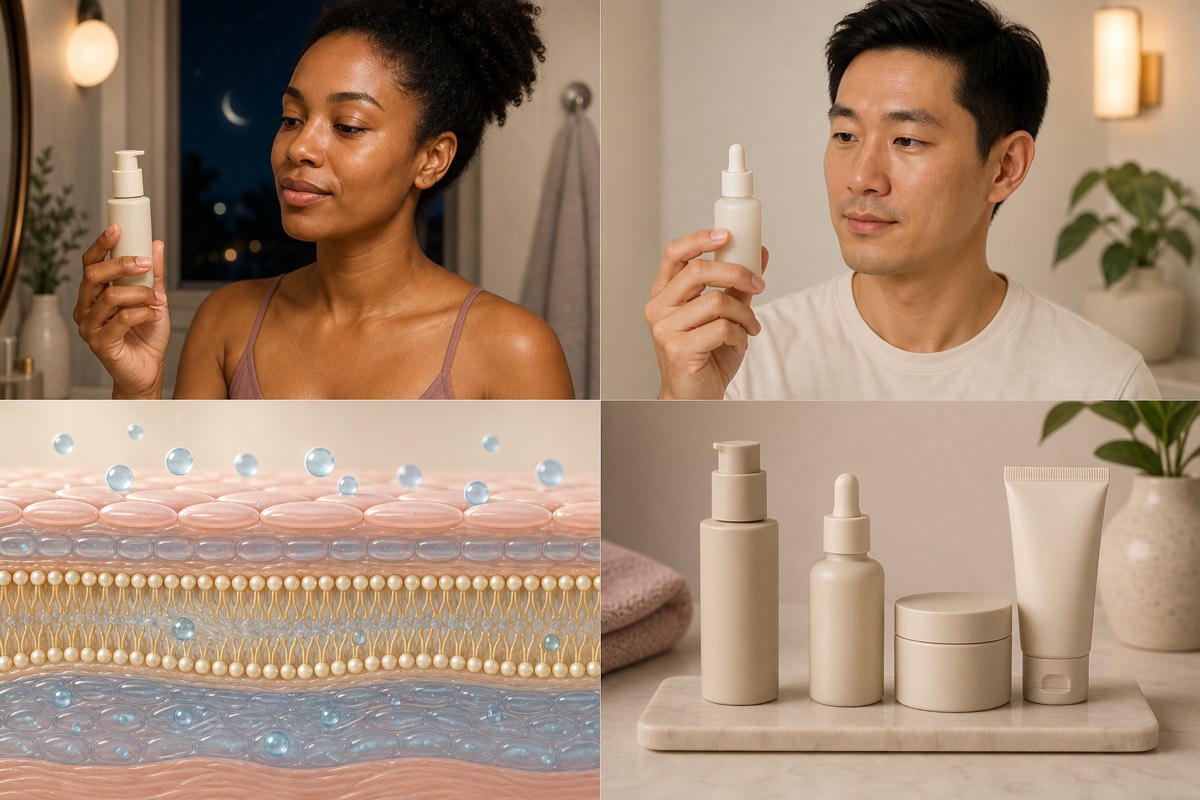
Combination evidence is formula-specific
Niacinamide, also called nicotinamide, is a vitamin B3 derivative used in many cleansers, serums and moisturizers. Reviews describe evidence for barrier, pigmentation and appearance outcomes, but the vehicle, concentration, population and measured endpoint differ across studies. The ingredient name alone does not predict how one bottle will feel on one person’s skin.
Some studies examine a finished formula containing a retinoid and niacinamide; others test a barrier moisturizer containing niacinamide plus panthenol and vitamin E alongside tretinoin. Those designs can support the tested regimen, but they do not establish a universal order for two independently formulated serums.
A 2024 randomized five-day patch study in 18 Chinese adults directly tested several potential retinol-irritation mitigants. In that narrow experiment, 3% niacinamide did not relieve retinol-induced discomfort. That result does not make the combination incompatible, but it does contradict a guarantee that niacinamide automatically buffers every retinol reaction.
Deeper visual interpretation
Compatibility, order and irritation control are three different questions. A finished product can be formulated with both ingredients, yet that does not validate every pair of separate bottles or make a reaction harmless.
| Pattern | What it can simplify | What it does not prove |
|---|---|---|
| One co-formulated product | One label, vehicle and application instruction | That every concentration or competing product has the same tolerability |
| Two separate products in one routine | Keeps both steps in one session when the formulas and skin tolerate it | That niacinamide prevents retinol irritation or that order never matters |
| Separated routines or alternate nights | Reduces simultaneous variables and makes reactions easier to attribute | That separation is required for everyone or creates better results |
| Retinoid plus basic moisturizer | Prioritizes a stable barrier-support step with fewer active variables | That a moisturizer treats a severe reaction or overrides prescription instructions |
Build the routine around evidence you actually have
- Separate the product from the ingredient
Record the complete formula, concentration, vehicle and label—not only the words niacinamide and retinol.
- Introduce the first variable
Keep cleanser, moisturizer and sunscreen unchanged while one new formula earns its place through tolerability.
- Choose the simplest second step
A co-formulated product follows one label. With separate products, same-session layering, morning/night separation and alternate nights are different experiments.
- Treat symptoms as data
Burning, rash and persistent peeling call for simplification and advice, not a higher niacinamide percentage to force continued retinoid use.
How to interpret the sequence
This sequence organizes product identification, introduction, separation and troubleshooting. It cannot determine whether a specific formula suits eczema, rosacea, acne, pigment concerns, pregnancy planning or prescription treatment.
Use it to keep cause and effect readable. It does not establish that every pair of active formulas is compatible, or that using more products produces faster results.
Routine safety principles
- Read both complete ingredient lists; another acid, fragrance or solvent may matter more than the headline ingredient.
- Introduce one new formula at a time instead of beginning a niacinamide serum and retinoid on the same day.
- Use the retinoid only as labeled or prescribed, generally at night, and maintain daytime sun protection.
- Do not assume a higher niacinamide percentage is more protective or that it neutralizes retinol irritation.
- Do not use retinoids during pregnancy. Discuss pregnancy planning, breastfeeding, prescription treatment and persistent skin disease with an appropriate clinician.
Stop the new product and seek professional advice for marked swelling, hives, blistering, eye involvement, intense pain, a widespread rash or irritation that does not improve after stopping. Breathing difficulty or facial or throat swelling requires emergency care.
Why your tolerance may differ
Questions to answer before combining them
- Is the vitamin A product retinol, retinal, adapalene, tretinoin or another retinoid?
- Are niacinamide and the retinoid in one deliberately formulated product or two separate products?
- What concentration, vehicle, fragrance and additional active ingredients are present?
- Would morning/night separation or alternate nights make a reaction easier to identify?
- Is pregnancy, pregnancy planning, breastfeeding, eczema, rosacea, acne medication or another prescription relevant?
Retinoid prescription status, cosmetic labels, ingredient naming and sunscreen standards vary by market. Follow the local label and prescribing instructions for the exact product rather than copying a schedule designed around a different formula or country.
Find official checks for 12 marketsHow this guide was made
5 named sources support the main claims. Each link explains how it was used, with public agencies, professional bodies or primary research preferred.
AI may assist with research organization, drafting and translation, but it is not treated as a source or credential. Read the editorial standards.
Stage bars organize a relative sequence. Original editorial illustrations are conceptual and are not clinical measurements, outcome percentages or personal forecasts.
This version has editorial evidence review, not medical review attributed to a named clinician. It does not replace an individual assessment. Editorial accountability.
Sources
- American Academy of Dermatology: Retinoid or Retinol?
Retinoid and retinol differences, gradual introduction, irritation, pregnancy restriction, night use, moisturizer and daytime sun protection.
- American Academy of Dermatology: How to Test Skin Care Products
A seven-to-10-day method for testing a new product and actions to take if a reaction develops.
- Niacinamide: A Review on Dermal Delivery Strategies and Clinical Evidence
A 2024 review of topical niacinamide mechanisms, formulation, permeation and clinical evidence across cosmetic and dermatologic uses.
- Mitigation of Retinol-Induced Skin Irritation by Physiologic Lipids
An 18-person randomized patch study in which 3% niacinamide did not relieve retinol-induced discomfort; the narrow design does not answer every routine question.
- Facilitating Facial Retinization Through Barrier Improvement
A split-face study of a multi-ingredient barrier moisturizer used before and during tretinoin—not a test of arbitrary niacinamide serum layering.
Frequently asked questions
What should I know about Niacinamide and Retinol Together?
Niacinamide and retinol can appear in the same skincare regimen, including in products formulated with both. That does not prove that every two separate serums should be layered in one application or that niacinamide will prevent retinol irritation. Introduce one product at a time, follow the exact retinoid instructions and use a stable moisturizer and daytime sunscreen. If using two separate formulas together is uncomfortable or hard to interpret, separate them by morning and night or alternate nights.
Why can tolerance differ from person to person?
The exact ingredient, formula, amount, frequency, other products, skin condition and medication can all change tolerance. Product labels and individualized professional instructions take priority over a general routine.
When should I contact a professional?
Stop the new product and seek professional advice for marked swelling, hives, blistering, eye involvement, intense pain, a widespread rash or irritation that does not improve after stopping. Breathing difficulty or facial or throat swelling requires emergency care.
Put the ingredients into an AM/PM order
Arrange cleanser, treatment serums, retinoid, moisturizer and sunscreen in the free browser-local tool without creating an account or saving your selections.
Open the skincare routine builderOpen the complete retinol guide
Connect product identity, gradual introduction, benefits, irritation, pregnancy and all five focused guides without treating every retinoid as the same product.
Explore the retinol topic hubRelated beauty guides
View SkincareMicroneedling Aftercare Timeline: First 24 Hours to Week 1
What redness, sensitivity and visible recovery can look like after microneedling, with aftercare and safety notes.
Read next SKINCAREMicroneedling vs Chemical Peel: Scars, Pigmentation, Downtime and Risks
Compare microneedling and chemical peels for acne scars, pigmentation, skin tone, downtime, treatment series, procedure-specific risks and questions to ask.
Read next SKINCARERetinol vs Tretinoin: Strength, Results, Irritation and Use
Compare cosmetic retinol and prescription tretinoin by product status, evidence, irritation, routine use and pregnancy precautions.
Read nextThis guide is for general education only. It is not medical advice, diagnosis, a treatment recommendation or a prediction of individual results. BeautiNext is not a clinic. Seek care from an appropriately qualified professional.