
Retinol Irritation vs Purging: How to Tell the Difference
A practical comparison of dryness, burning, peeling and acne changes after starting retinol or a prescription retinoid.
Retinol Irritation vs Purging
Dryness, stinging, redness and peeling point toward irritation, especially when they extend beyond acne-prone areas. New breakouts are sometimes described as purging, but worsening or persistent acne should not automatically be dismissed. Product strength, frequency, other active ingredients and the underlying skin condition all need consideration.
Timeline at a glance
The word “purging” is often used online as a reason to continue through any reaction. A safer interpretation starts by separating barrier irritation from acne activity.
Check the sensation
Burning, marked stinging, tightness or widespread redness is a reason to evaluate irritation rather than assuming a normal adjustment.
Look at location and pattern
Dryness and peeling outside usual breakout areas can suggest that the routine is too irritating.
Review the full routine
Other exfoliants, benzoyl peroxide, fragrance and frequent application can increase irritation.
Get individualized advice
Painful, scarring, widespread or steadily worsening acne and irritation deserve professional assessment.
The bars show relative visibility within this guide only. They are not percentages, clinical measurements or personal forecasts.
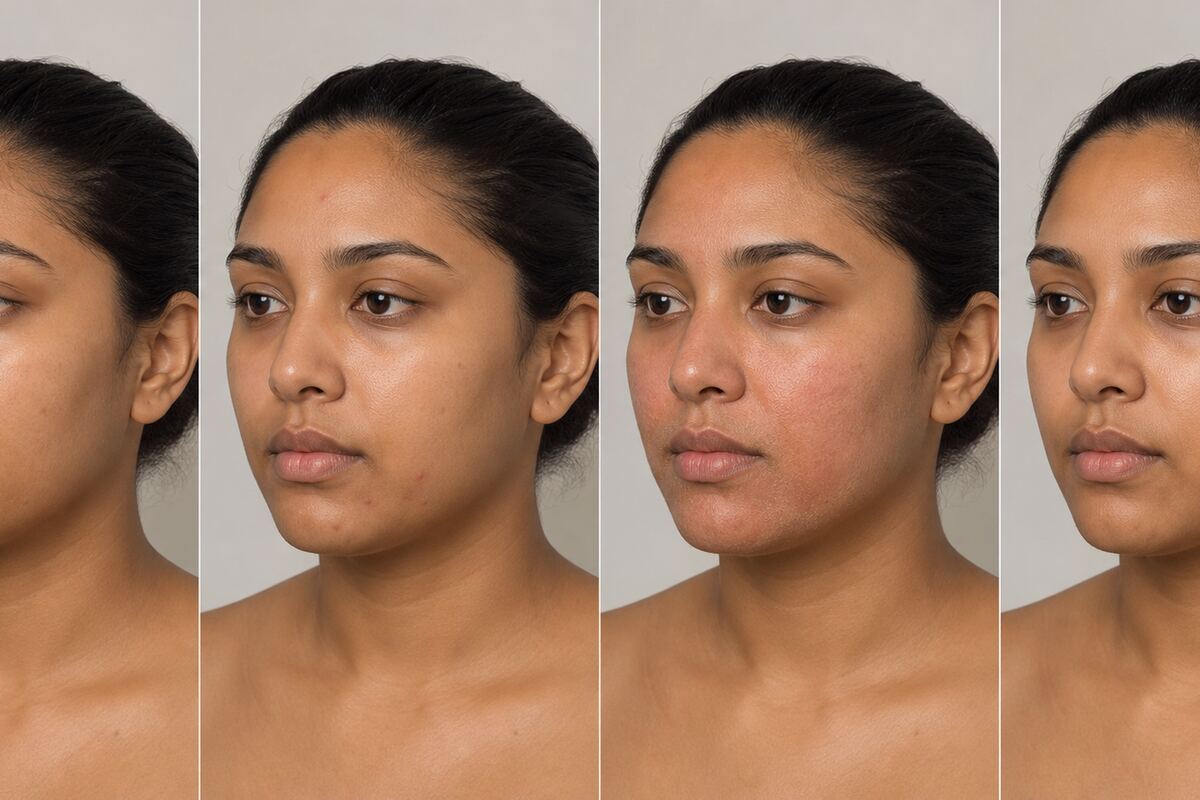
Why irritation can be mistaken for progress
Retinoids influence skin-cell turnover and can help prevent clogged pores, but they can also disrupt a routine that the skin was tolerating. Burning, widespread peeling and persistent redness are signs to assess irritation rather than proof that a stronger product is working better.
Online “purging” timelines often ignore formulation strength, application amount, other active ingredients and the original acne pattern. A safer decision uses symptoms and distribution, then adjusts with professional advice when the reaction is significant.
Deeper visual interpretation
‘Purging’ is often used as a blanket explanation for any bad reaction. Location, lesion type, timing and accompanying burning or scaling provide more useful clues than the label alone.
| Pattern | Where and when | Safer next question |
|---|---|---|
| Irritation | Burning, tightness, diffuse redness or scaling; can extend beyond usual breakout zones | Is the frequency, amount or combination of active products too aggressive? |
| Acne flare during turnover change | Breakouts in areas already prone to acne after starting an active | How long is reasonable to observe before reassessment? |
| Possible allergic or severe reaction | Marked swelling, hives, blistering, eye involvement or breathing symptoms | What urgent care is needed now? |
How to interpret the stages
A recovery timeline combines broad observations from published patient guidance. It cannot know the exact product or device, treatment depth, technique, medical history, skin characteristics or aftercare plan involved in one person’s case.
Use the stages to understand the order in which changes may happen and to prepare questions for a qualified professional. Do not use a general internet timeline to override instructions from the clinician who assessed and treated you.
Aftercare principles
- Start with the least-intense suitable formula and increase slowly if appropriate.
- Use moisturizer and sun protection as advised.
- Avoid stacking multiple irritating actives without a clear plan.
- Do not use retinoids during pregnancy; discuss suitable alternatives with a clinician.
Stop the product and seek advice for severe swelling, blistering, a significant allergic-type reaction, eye involvement, intense pain or irritation that does not settle after stopping.
Why your timeline may differ
Questions to ask before treatment
- Is this retinol, adapalene or a prescription retinoid?
- Which other actives should be paused or separated?
- What reaction means I should stop and seek advice?
Over-the-counter and prescription classifications differ between countries. Check the actual ingredient and concentration rather than assuming products with similar marketing names are equivalent.
Find official checks for 12 marketsHow this guide was made
3 named sources support the main claims. Each link explains how it was used, with public agencies, professional bodies or primary research preferred.
AI may assist with research organization, drafting and translation, but it is not treated as a source or credential. Read the editorial standards.
Stage bars organize a relative sequence. Original editorial illustrations are conceptual and are not clinical measurements, outcome percentages or personal forecasts.
This version has editorial evidence review, not medical review attributed to a named clinician. It does not replace an individual assessment. Editorial accountability.
Sources
- American Academy of Dermatology: Retinoid or Retinol?
Differences between retinoids and retinol, suitability, irritation and safer introduction.
- AAD: Acne Diagnosis and Treatment
Retinoid irritation and dermatologist-guided ways to reduce it.
- NHS: Acne Treatment
Topical retinoid use, common irritation and stinging, sun precautions and pregnancy restrictions.
Frequently asked questions
What should I know about Retinol Irritation vs Purging?
Dryness, stinging, redness and peeling point toward irritation, especially when they extend beyond acne-prone areas. New breakouts are sometimes described as purging, but worsening or persistent acne should not automatically be dismissed. Product strength, frequency, other active ingredients and the underlying skin condition all need consideration.
Why can the timeline differ from person to person?
Treatment type, depth, technique, anatomy, skin and tissue response, health history, medication, aftercare and complications can all change timing. The treating professional’s instructions take priority over a general guide.
When should I contact a professional?
Stop the product and seek advice for severe swelling, blistering, a significant allergic-type reaction, eye involvement, intense pain or irritation that does not settle after stopping.
Put the ingredients into an AM/PM order
Arrange cleanser, treatment serums, retinoid, moisturizer and sunscreen in the free browser-local tool without creating an account or saving your selections.
Open the skincare routine builderOpen the complete retinol guide
Connect product identity, gradual introduction, benefits, irritation, pregnancy and all five focused guides without treating every retinoid as the same product.
Explore the retinol topic hubRelated beauty guides
View SkincareMicroneedling Aftercare Timeline: First 24 Hours to Week 1
What redness, sensitivity and visible recovery can look like after microneedling, with aftercare and safety notes.
Read next SKINCAREMicroneedling vs Chemical Peel: Scars, Pigmentation, Downtime and Risks
Compare microneedling and chemical peels for acne scars, pigmentation, skin tone, downtime, treatment series, procedure-specific risks and questions to ask.
Read next SKINCARERetinol vs Tretinoin: Strength, Results, Irritation and Use
Compare cosmetic retinol and prescription tretinoin by product status, evidence, irritation, routine use and pregnancy precautions.
Read nextThis guide is for general education only. It is not medical advice, diagnosis, a treatment recommendation or a prediction of individual results. BeautiNext is not a clinic. Seek care from an appropriately qualified professional.