
HAIRLINE & SCALP · ILLUSTRATED 3D RECOVERY
Hair Transplant (Frontal Hairline): before & after and recovery stages
Follow short implanted hairs through shedding and a slower period of new growth.
SUMMARY
What this example shows
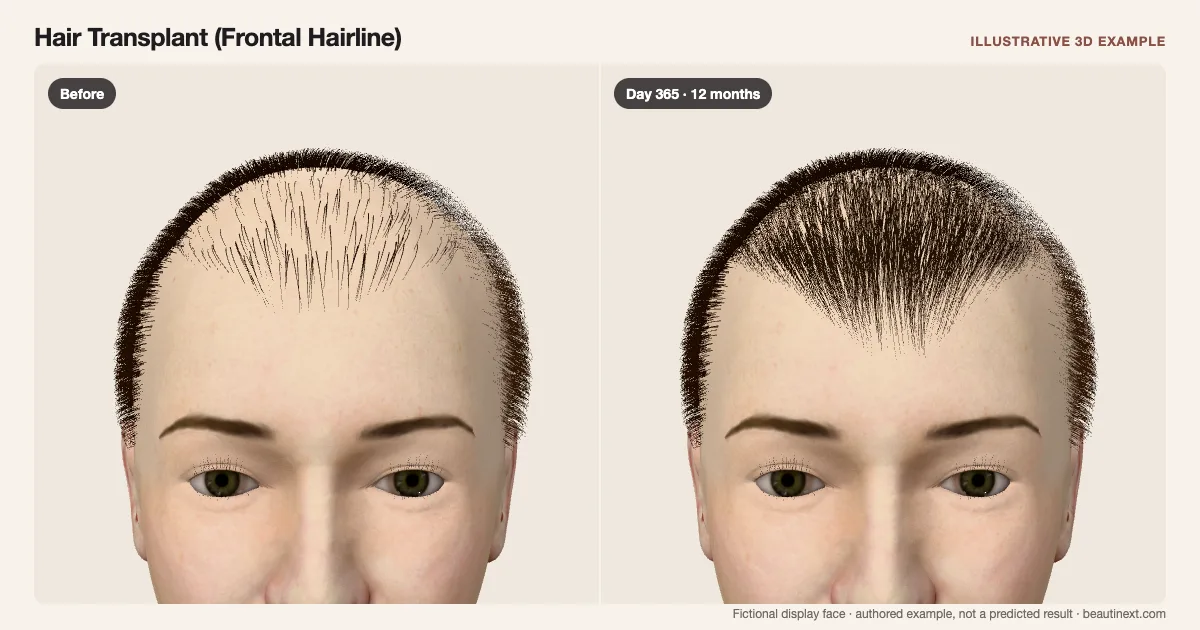
A cropped-hair display exposes a fixed frontal recipient area that starts with sparse hair. Short implanted shafts appear, shed in the early weeks and are followed by gradual illustrative growth. Existing hair behind this patch stays fixed. This does not model graft survival, donor scars, crown coverage, medication response or future hair loss.
STAGE BY STAGE
Hair Transplant (Frontal Hairline) recovery stages
Before treatment
This cropped-hair reference has a fictional sparse frontal patch. The recipient area stays fixed while the illustrated strands shed and grow.
First week: Short hairs & surface response
Short shafts and small crusts appear in the recipient area.
Early visibility does not establish graft survival.
Around 2 months: Shedding interval
The frontal patch becomes sparse again.
Implanted shafts often shed in the early weeks; follicles are not shown.
Around 6 months: Growth developing
More and longer strands become visible.
New growth develops gradually; timing and coverage vary.
Around 1 year: Later growth example
The fixed recipient area looks fuller.
Some results continue developing beyond a year.
TIMELINE
Day-by-day checkpoints in the 3D model
The simulator interpolates between these authored checkpoints. They describe the illustration, not measured clinical averages.
This cropped-hair reference has a fictional sparse frontal patch. The recipient area stays fixed while the illustrated strands shed and grow.
The frontal recipient area is an authored example, not a graft count or predicted density.
The frontal recipient area is an authored example, not a graft count or predicted density.
The frontal recipient area is an authored example, not a graft count or predicted density.
The frontal recipient area is an authored example, not a graft count or predicted density.
The frontal recipient area is an authored example, not a graft count or predicted density.
The frontal recipient area is an authored example, not a graft count or predicted density.
The frontal recipient area is an authored example, not a graft count or predicted density.
The frontal recipient area is an authored example, not a graft count or predicted density.
The frontal recipient area is an authored example, not a graft count or predicted density.
The frontal recipient area is an authored example, not a graft count or predicted density.
The frontal recipient area is an authored example, not a graft count or predicted density.
INDIVIDUAL DIFFERENCES
How recovery can vary
Timing and response
Front hair is shown cropped for comparison. This fictional sparse frontal patch is the same for every stage and is not inferred from gender or regional face. Graft count, survival and donor coverage are not calculated.
Longer term
The timeline extends to 18 months. Native hair can continue thinning; this model does not predict that loss or the need for another treatment.
EVIDENCE NOTES
Sources and limitations
- NHS: Hair transplant
Early scalp swelling and temporary scabs, shedding after weeks, new growth around four months and fuller results over 10–18 months.
- AAD: Hair transplant results
Shaft shedding in weeks 2–8, a sparse period and results commonly visible over 6–12 months. Exact density and strand lengths here are authored.
KEEP COMPARING
Other hairline & scalp examples
This illustration is not medical advice, diagnosis, a treatment recommendation or a prediction of personal results. Swelling, color, contour and dates are authored examples on a fictional face. BeautiNext is not a clinic; your treating team’s assessment and written recovery plan take priority.