
HAIRLINE & SCALP · ILLUSTRATED 3D RECOVERY
Hairline Lowering (Forehead Reduction): before & after and recovery stages
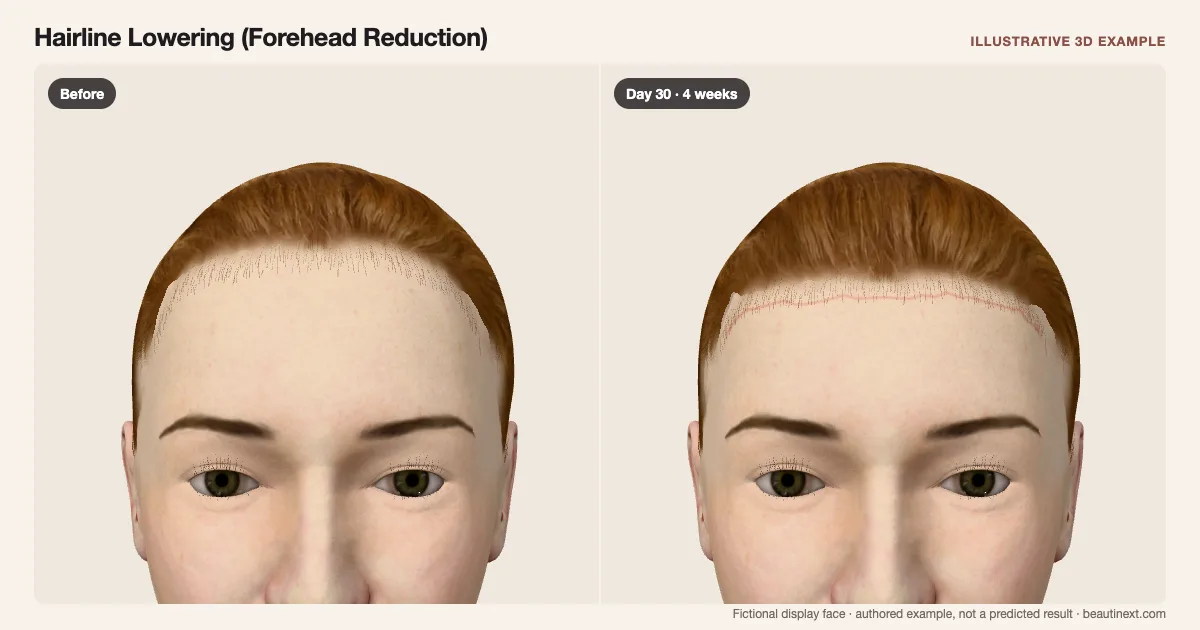
Compare a lower existing hairline, early stitches and the later residual incision line.
SUMMARY
What this example shows
The existing hairstyle moves lower over the forehead. Optional stitches follow the closed hairline incision, then disappear while a fading scar remains. Hair is repositioned rather than grown. Brow position, bone, scalp laxity, fixation and individual scar quality are not reconstructed.
STAGE BY STAGE
Hairline Lowering (Forehead Reduction) recovery stages
Before treatment
The existing hairstyle is preserved as its front boundary moves lower in this example.
First few days: Lower edge with stitches
Small stitches cross a closed line beneath the moved hair boundary, with local fullness and color.
Closure marks can be hidden. This illustrates scalp advancement, not new hair growth or an open wound.
Around 1 week: After example stitch removal
Stitch marks disappear while the closed line and some early color remain.
The clinic describes removal usually at day 5 or 7. Day 7 here is a display switch; actual closure and timing vary.
Around 1 month: Lower hairline and residual line
The existing boundary remains lower, with a visible incision line after much of the early fullness eases.
The lower contour and residual mark have separate tracks. Their strength is illustrative, not a measured recovery curve.
Around 6 months: Fainter residual scar
The same hairline retains a fainter line after the early swelling fades.
Scars may continue changing beyond this view. The general scar source does not establish a hairline-specific six-month result.
TIMELINE
Day-by-day checkpoints in the 3D model
The simulator interpolates between these authored checkpoints. They describe the illustration, not measured clinical averages.
The existing hairstyle is preserved as its front boundary moves lower in this example.
A lower front boundary appears alongside local fullness.
Forehead fullness can obscure the new boundary.
The local surface response begins easing in this illustration.
Less surface color makes the lower edge easier to compare.
The example hairline remains lower as early fullness recedes.
A fainter residual line remains at the lowered hairline; it does not predict scar healing.
Hairline stability and scars require individual follow-up.
INDIVIDUAL DIFFERENCES
How recovery can vary
Timing and response
The existing hairstyle stays intact as the front boundary moves. Scalp mobility, starting hairline and surgical technique limit possible advancement. The contour setting does not prescribe a distance.
Longer term
A residual line remains in this example. Scar width, color, thickening and hair coverage vary; sensation, shedding and later hair loss are not reconstructed. Six months does not mean scar maturation is complete.
EVIDENCE NOTES
Sources and limitations
- Mayo Clinic: Hairline lowering
Scalp advancement and removal of forehead skin, distinguished from transplantation. Its recovery discussion covers combined facial surgery, not an isolated-operation timetable.
- Utah Facial Plastics: Forehead reduction · Postoperative instructions
A surgical clinic's hairline-incision care, early swelling/bruising and sutures or staples; removal is usually described at day 5 or 7. This supports the closure context, not the painted shape, intensity or individual timing.
- University of Utah Health: General surgical scar maturation
General scar maturation can take a year or longer, and scars are not completely erased. This is scar-healing context, not a hairline-specific study or validation of the displayed six-month fading curve.
- Aesthetic Surgery Journal: Hairline lowering follow-up study
A retrospective study measured a lower hairline at one month and later follow-up. It does not establish an individual amount or an early swelling curve.
KEEP COMPARING
Other hairline & scalp examples
This illustration is not medical advice, diagnosis, a treatment recommendation or a prediction of personal results. Swelling, color, contour and dates are authored examples on a fictional face. BeautiNext is not a clinic; your treating team’s assessment and written recovery plan take priority.