
Acne Scar Treatments Compared: Laser, Microneedling, Peels and Fillers
Why acne scar type, skin tone, downtime and active acne matter when comparing common treatment options.
Acne Scar Treatment Comparison
There is no single best acne scar treatment. Depressed, raised and keloid scars require different approaches, and many plans combine procedures. A dermatologist may consider scar type, active acne, skin tone, downtime, budget and prior medication before recommending lasers, microneedling, peels, fillers, radiofrequency or minor surgery.
Timeline at a glance
Comparing treatment names without identifying the scar type first is like comparing tools without knowing the job.
Control active acne
Ongoing breakouts can create new scars, so scar treatment often starts after acne is under better control.
Identify scar type
Ice-pick, rolling, boxcar, raised and keloid scars do not respond to the same procedures.
Compare tradeoffs
Downtime, skin tone, number of sessions, cost, pigment risk and expected degree of improvement all matter.
Combine and reassess
More than one treatment is often used, with progress assessed over multiple visits rather than one session.
The bars show relative visibility within this guide only. They are not percentages, clinical measurements or personal forecasts.
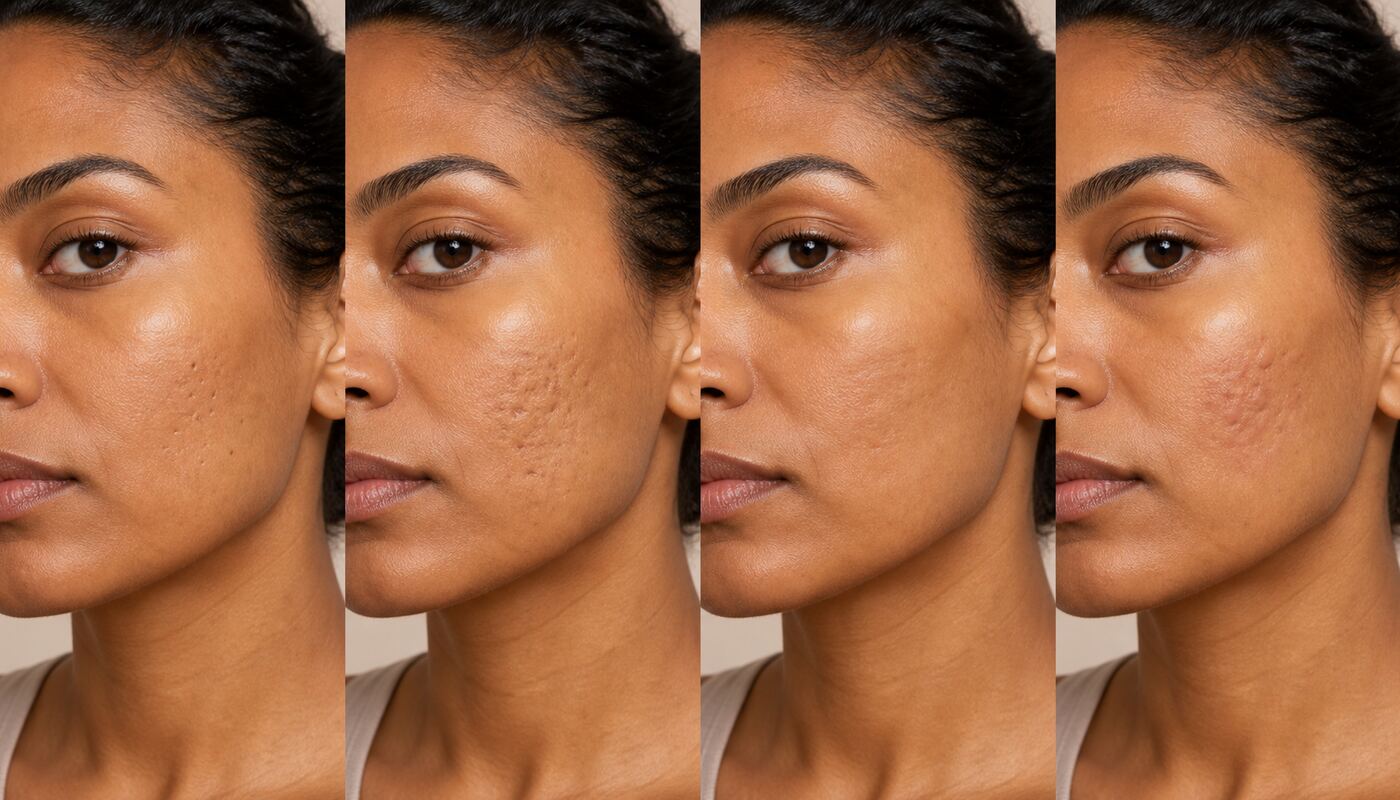
Why scar type comes before treatment name
Depressed scars form where healing leaves too little supporting collagen, while raised scars and keloids involve excess scar tissue. Ice-pick, rolling and boxcar patterns also differ in depth and shape, so one device cannot be assumed to suit all of them.
Dermatologists often combine methods that release, fill, resurface or remodel different scar components. Skin tone, active acne, recent medication and pigment tendency influence which sequence is safer.
Deeper visual interpretation
Scar family comes before device name. A surface treatment, a method that releases tethering, a volume-restoring option and a treatment for excess scar tissue answer different structural questions, so a clinic menu is not yet an individualized plan.
| Pattern to assess | Structural question | Do not assume |
|---|---|---|
| Ice-pick-like narrow depressions | How deep and focal are the openings? | That broad resurfacing reaches every narrow deep scar |
| Boxcar-like depressions | How sharp are the edges and how deep is the floor? | That every boxcar scar needs the same depth or device |
| Rolling or tethered depressions | Is deeper attachment pulling the surface downward? | That changing only the surface releases tethering |
| Raised or keloid scars | Is excess scar tissue still active or extending beyond the original area? | That a depressed-scar filling or resurfacing plan applies |
Create a comparison record before the consultation
- Control the light
Use the same side-light direction, camera distance and neutral expression; flat front light can hide depressions.
- Record active acne separately
Mark ongoing breakouts and current medication because preventing new scars can come before procedural scar treatment.
- Document pigment history
Write down darkening or lightening after inflammation and how long it lasted; a photograph alone cannot capture that history.
- Name the exact intervention
Record device model, wavelength or energy type, needle depth, peel strength, injectable and operator—not only a marketing package name.
How to interpret the stages
A recovery timeline combines broad observations from published patient guidance. It cannot know the exact product or device, treatment depth, technique, medical history, skin characteristics or aftercare plan involved in one person’s case.
Use the stages to understand the order in which changes may happen and to prepare questions for a qualified professional. Do not use a general internet timeline to override instructions from the clinician who assessed and treated you.
Aftercare principles
- Avoid picking active breakouts because inflammation increases scarring risk.
- Tell the dermatologist about acne medications used within the last two years.
- Ask how the proposed device or peel performs on your skin tone.
- Plan for multiple sessions and post-treatment sun protection when advised.
Procedures performed without correct scar diagnosis or experience with your skin tone can worsen pigment or scarring. Seek qualified assessment before aggressive at-home peels, needles or energy devices.
Why your timeline may differ
Questions to ask before treatment
- Which scar types are present and which treatment targets each one?
- How does the plan account for my skin tone and pigment history?
- Is active acne controlled before scar procedures begin?
- What exact device, depth, peel strength or injectable is proposed?
- How many sessions, how much downtime and what degree of improvement are realistic?
Device names can be marketed similarly despite different wavelengths, depths and regulatory clearance. Ask for the exact technology and the clinician’s experience treating the same scar type and skin tone.
Find official checks for 12 marketsHow this guide was made
3 named sources support the main claims. Each link explains how it was used, with public agencies, professional bodies or primary research preferred.
AI may assist with research organization, drafting and translation, but it is not treated as a source or credential. Read the editorial standards.
Stage bars organize a relative sequence. Original editorial illustrations are conceptual and are not clinical measurements, outcome percentages or personal forecasts.
This version has editorial evidence review, not medical review attributed to a named clinician. It does not replace an individual assessment. Editorial accountability.
Sources
- American Academy of Dermatology: Acne Scar Treatment
Scar assessment and the range of treatments used for depressed, raised and keloid scars.
- AAD: Acne Scars Overview
Scar prevention, natural fading limits and reasons to seek treatment.
- FDA: Microneedling Devices
Authorized uses, device limits, common and less-common risks, operator questions and skin-tone considerations in the United States.
Frequently asked questions
What should I know about Acne Scar Treatment Comparison?
There is no single best acne scar treatment. Depressed, raised and keloid scars require different approaches, and many plans combine procedures. A dermatologist may consider scar type, active acne, skin tone, downtime, budget and prior medication before recommending lasers, microneedling, peels, fillers, radiofrequency or minor surgery.
Why can the timeline differ from person to person?
Treatment type, depth, technique, anatomy, skin and tissue response, health history, medication, aftercare and complications can all change timing. The treating professional’s instructions take priority over a general guide.
When should I contact a professional?
Procedures performed without correct scar diagnosis or experience with your skin tone can worsen pigment or scarring. Seek qualified assessment before aggressive at-home peels, needles or energy devices.
Open the complete acne scar guide
Start with active acne, flat marks, depressed or raised scar patterns and skin-tone context before comparing exact procedures.
Explore the acne scar topic hubRelated beauty guides
View SkincareMicroneedling Aftercare Timeline: First 24 Hours to Week 1
What redness, sensitivity and visible recovery can look like after microneedling, with aftercare and safety notes.
Read next SKINCAREMicroneedling vs Chemical Peel: Scars, Pigmentation, Downtime and Risks
Compare microneedling and chemical peels for acne scars, pigmentation, skin tone, downtime, treatment series, procedure-specific risks and questions to ask.
Read next SKINCARERetinol vs Tretinoin: Strength, Results, Irritation and Use
Compare cosmetic retinol and prescription tretinoin by product status, evidence, irritation, routine use and pregnancy precautions.
Read nextThis guide is for general education only. It is not medical advice, diagnosis, a treatment recommendation or a prediction of individual results. BeautiNext is not a clinic. Seek care from an appropriately qualified professional.