
Facelift Recovery Timeline: Day 1 to Month 3
A week-by-week guide to facelift swelling, bruising, incision care, work return, activity limits and longer facial settling.
Explore this procedure in 3D
Turn the face, compare before treatment and move through the illustrative recovery stages for the selected region.
Compare recovery stages
Drag sideways to rotate · Pinch or scroll to zoom
Comparison, camera & procedure details
Two stages shown at the same angle and scale.
What changes in this example · 180 days after
Early days are spaced out so you can follow the visible changes.
- Less lower-cheek sagging
Some starting contour remains. This date does not guarantee a final result.
The starting jowls are fixed; the contour control adjusts only the illustrated lift. Extent, additional procedures and tissue response vary. Neck lifting is shown in its separate example. Dressings are hidden to show the skin.
Example contour
Fixed fictional jowls provide the starting reference. The same lower-cheek contour moves upward and inward while separate surgical swelling and color settle. Some starting laxity remains. Lips, ears, upper face and neck stay fixed; skin removal, deeper tissue planes and a particular facelift technique are not reconstructed.
Treatment date · Elapsed time
180 days after treatmentIllustrated range: 0–180 days
Customize display faceFemale · European / North American · Skin tone 4
Appearance settings only. Every face follows the same example recovery course.
Recovery at a glance
Lower-face lift
Compare fixed jowls with the same lower-face contour through early swelling and a later partial lift.
A general recovery example based on public medical guidance. Timing and visible changes vary from person to person.
The NHS describes full results developing over six to nine months. This surface example does not reconstruct deeper planes, skin removal or every facelift technique.
Facelift techniques: SMAS, deep plane and mini lift
SMAS is the supporting tissue beneath the skin. Modern lifts can reposition this layer; deep-plane and high-SMAS approaches differ in how the deeper tissue is accessed.
A mini lift treats a more limited area. Midface and neck lifts also target different regions, so one name does not describe the same operation for everyone.
Compare the selected region's visible contour here. Tissue layers, incision plans and differences in longevity between techniques are not simulated.
Sources & how this preview works
Public medical guidance informs the stage descriptions. The 3D swelling, color and contour changes are drawn examples, not patient measurements or a prediction of your result.
- NHS · Facelift
Lower-face loose skin and jowls, upward/backward repositioning, visible bruising and results developing over months. Starting contours, displacement and dates are authored examples.
- Cleveland Clinic · Bruise color changes
Explains complexion-dependent bruise colors and possible lighter brown, green or yellow as they fade. Color alone does not determine the recovery day.
Sources checked .
Read the complete recovery guideFacelift Recovery Timeline
Bruising and swelling commonly remain visible for two to three weeks after a facelift, while the face may take two to three months to feel more normal. Many people discuss returning to work around two to three weeks after a traditional facelift, but a mini-facelift, combined neck or eyelid surgery, job demands and the surgeon's technique can change that timeline.
Timeline at a glance
Facelift recovery has separate clocks for wound care, social visibility, work return and longer tissue settling. Looking ready to leave home does not mean the result is final or strenuous activity is safe.
Protected early recovery
Bandages and sometimes drains may be used while pain, bruising, swelling and incision sites are monitored. A responsible adult is commonly needed after discharge.
Visible changes begin easing
Dressings and sutures are managed according to the surgical plan. Bruising, swelling, tightness, numbness or tingling can still be obvious during the second week.
Work return may be discussed
Many people feel more presentable and may return to non-physical work, but the type of facelift, combined procedures and individual healing remain important.
Longer settling continues
Minor swelling, tightness, sensation and scar appearance can keep changing after daily routines resume. Later assessment belongs with the operating surgeon.
The bars show relative visibility within this guide only. They are not percentages, clinical measurements or personal forecasts.
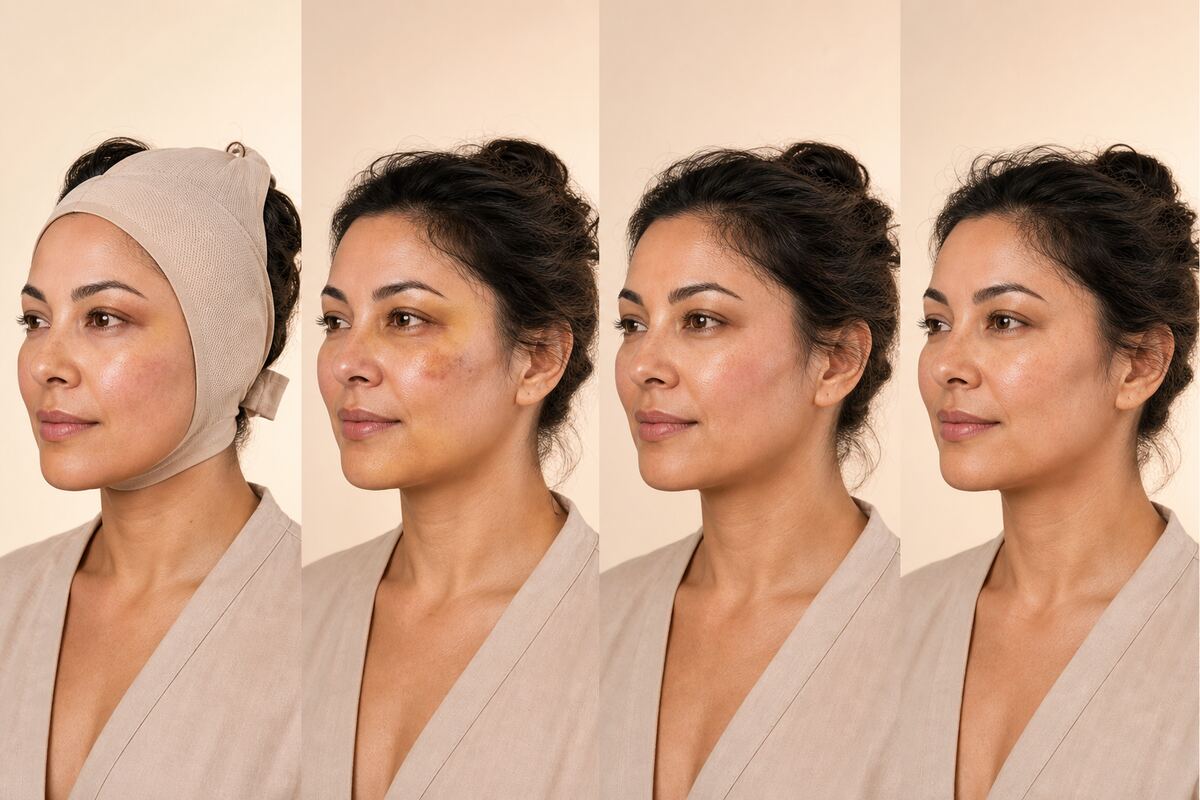
Why facelift recovery has more than one clock
A facelift repositions deeper facial tissues and skin through incisions placed around the ear, hairline or other technique-specific locations. Early bruising and swelling reflect surgery and tissue handling; later tightness, altered sensation, scar change and subtle swelling can persist after the face looks less obviously postoperative.
A mini, traditional, SMAS or deep-plane facelift does not describe one identical operation. A neck lift, eyelid surgery, fat transfer, resurfacing or another combined procedure can also change dressings, visible recovery, travel planning and activity restrictions. The operating surgeon’s written plan therefore takes priority over a generic calendar.
Deeper visual interpretation
A useful facelift plan separates the wound-care clock, the social-visibility clock, the activity-clearance clock and the longer settling clock. A face that looks less bruised can still have healing incisions, altered sensation and restrictions that are not visible in a photograph.
| Clock | What it tracks | Do not confuse it with |
|---|---|---|
| Wound care | Dressings, drains, sutures and incision checks | Being ready for makeup, hair styling or travel |
| Social visibility | How noticeable bruising and swelling appear | Medical clearance for work or exercise |
| Activity clearance | Driving, lifting, strenuous exercise and physical work | The face looking settled in ordinary lighting |
| Longer settling | Residual swelling, sensation, tightness and scar maturation | A guaranteed final result date |
Plan the first follow-up before surgery
- Name the responsible team
Record who answers routine and urgent questions, including outside normal clinic hours.
- Write down each restriction
Keep work, driving, exercise, lifting, hair washing and travel dates separate rather than asking only when recovery ends.
- Preserve treatment records
Keep the operative summary, anesthesia information, medication list and postoperative instructions accessible if care is needed elsewhere.
- Protect review access
International travel should not remove access to incision, bleeding, swelling or infection assessment during the early recovery period.
How to interpret the stages
A recovery timeline combines broad observations from published patient guidance. It cannot know the exact product or device, treatment depth, technique, medical history, skin characteristics or aftercare plan involved in one person’s case.
Use the stages to understand the order in which changes may happen and to prepare questions for a qualified professional. Do not use a general internet timeline to override instructions from the clinician who assessed and treated you.
Aftercare principles
- Arrange transport and an adult to stay during the early recovery period specified by the surgical team.
- Follow the exact incision, drain, bandage, hair-washing and head-elevation instructions supplied by the surgeon.
- Avoid strenuous exercise until the surgeon provides individual clearance; feeling socially ready is not exercise clearance.
- Keep scheduled postoperative visits so the team can assess swelling, bruising, incisions and suture or drain management.
Contact the surgical team immediately for bleeding that saturates a bandage, extreme or rapidly increasing swelling, fever, pus or abnormal discharge, severe or worsening pain, breathing difficulty, chest pain or any urgent symptom listed in the discharge plan.
Why your timeline may differ
Questions to ask before treatment
- What exact facelift technique and combined procedures are planned?
- Who will manage anesthesia, overnight observation and an emergency transfer if needed?
- When are dressings, drains and sutures normally reviewed or removed?
- Which dates apply to desk work, driving, exercise, lifting and air travel in this plan?
- Who provides urgent review after hours and after I return home?
Facial-plastic and plastic-surgery titles, facility oversight, anesthesia rules and postoperative access differ across countries. Verify the surgeon and facility locally, and do not book international travel without a written follow-up and complication plan.
Find official checks for 12 marketsHow this guide was made
2 named sources support the main claims. Each link explains how it was used, with public agencies, professional bodies or primary research preferred.
AI may assist with research organization, drafting and translation, but it is not treated as a source or credential. Read the editorial standards.
Stage bars organize a relative sequence. Original editorial illustrations are conceptual and are not clinical measurements, outcome percentages or personal forecasts.
This version has editorial evidence review, not medical review attributed to a named clinician. It does not replace an individual assessment. Editorial accountability.
Sources
- Cleveland Clinic: Facelift (Rhytidectomy)
Facelift types, early support, bruising and swelling, work return, activity limits and symptoms requiring prompt contact.
- American Society of Plastic Surgeons: Facelift Recovery Day 1 to Day 30
A broad first-month sequence covering dressings, peak swelling, incision care, activity and return to routine.
Frequently asked questions
What should I know about Facelift Recovery Timeline?
Bruising and swelling commonly remain visible for two to three weeks after a facelift, while the face may take two to three months to feel more normal. Many people discuss returning to work around two to three weeks after a traditional facelift, but a mini-facelift, combined neck or eyelid surgery, job demands and the surgeon's technique can change that timeline.
Why can the timeline differ from person to person?
Treatment type, depth, technique, anatomy, skin and tissue response, health history, medication, aftercare and complications can all change timing. The treating professional’s instructions take priority over a general guide.
When should I contact a professional?
Contact the surgical team immediately for bleeding that saturates a bandage, extreme or rapidly increasing swelling, fever, pus or abnormal discharge, severe or worsening pain, breathing difficulty, chest pain or any urgent symptom listed in the discharge plan.
Separate tissue repositioning from volume transfer
A facelift and facial fat transfer answer different anatomical questions and may be combined, changing both the donor-site and facial recovery plan.
Read facial fat transfer recoveryCompare this recovery time
See this treatment beside 10 other skincare, injectable, surgical, body and hair timelines without treating the ranges as personal clearance dates.
Open the 11-treatment comparisonRelated beauty guides
View Plastic SurgeryRhinoplasty Aftercare: Sleeping, Glasses, Exercise and Nose Blowing
Rhinoplasty aftercare for sleep position, glasses, nose blowing, work and exercise—with source differences and surgeon-specific limits.
Read next PLASTIC SURGERYRhinoplasty vs Septoplasty: Appearance, Breathing, Recovery and Risks
Compare rhinoplasty and septoplasty by treatment goal, anatomy, breathing, recovery, risks and when both may be combined.
Read next PLASTIC SURGERYRhinoplasty Recovery Timeline: Week 1 to One Year
A broad rhinoplasty recovery timeline covering splints, early return, swelling and the long refinement period.
Read nextThis guide is for general education only. It is not medical advice, diagnosis, a treatment recommendation or a prediction of individual results. BeautiNext is not a clinic. Seek care from an appropriately qualified professional.