
Facial Fat Transfer Recovery: Swelling, Results and Risks
Follow facial fat transfer recovery across donor-site bruising, facial swelling, graft settling, result review and urgent vascular warning signs.
Explore this procedure in 3D
Turn the face, compare before treatment and move through the illustrative recovery stages for the selected region.
Compare recovery stages
Drag sideways to rotate · Pinch or scroll to zoom
Comparison, camera & procedure details
Two stages shown at the same angle and scale.
Compare the same side at both stages. Use Full face to see both sides.
What changes in this example · 180 days after
Early days are spaced out so you can follow the visible changes.
- Fuller cheek contour
The six-month comparison does not estimate fat survival or future volume.
Transferred volume, technique and individual healing affect the course. Changing this display face does not estimate fat survival.
Example contour
Both cheek compartments gain illustrative volume. Early swelling exaggerates fullness, then the model separates settling from the later retained-volume example.
Treatment date · Elapsed time
180 days after treatmentIllustrated range: 0–180 days
Customize display faceFemale · European / North American · Skin tone 4
Appearance settings only. Every face follows the same example recovery course.
Recovery at a glance
Cheek fat transfer
Follow temporary cheeks fullness as it settles after fat transfer.
A general recovery example based on public medical guidance. Timing and visible changes vary from person to person.
Fat-transfer results can take about six months to assess; not all transferred fat survives.
Volume fat grafting and nanofat
Structural fat grafting adds volume. Nanofat is further processed and filtered, with a different focus on skin quality rather than substantial structural support.
The timeline here illustrates added volume and swelling. It does not model nanofat skin changes, harvesting methods or individual graft survival.
Sources & how this preview works
Public medical guidance informs the stage descriptions. The 3D swelling, color and contour changes are drawn examples, not patient measurements or a prediction of your result.
- Cleveland Clinic · Fat transfer
Temporary swelling and bruising; volume assessment over several months.
- Cleveland Clinic · Fat injections
Facial injection-site reactions and variable recovery.
- Cleveland Clinic · Bruise color changes
Explains complexion-dependent bruise colors and possible lighter brown, green or yellow as they fade. Color alone does not determine the recovery day.
Sources checked .
Read the complete recovery guideFacial Fat Transfer Recovery
Facial fat transfer has at least two recovery sites and three clocks. Fat is harvested from a donor area, processed and placed into selected facial tissue; early facial fullness therefore combines swelling with transferred fat, while the donor area may have separate bruising, soreness and compression instructions. Swelling and bruising can remain visible for weeks, but a stable retained volume cannot be read from an early photograph or predicted by one universal percentage. Longer review commonly extends across months, and another procedure may be discussed. Sudden vision change, severe eye pain, one-sided weakness, speech difficulty, severe headache or rapidly changing pale or dusky skin is an emergency—not normal settling.
Timeline at a glance
A useful timeline keeps the donor site, facial recipient site and graft-retention question separate. It also distinguishes routine postoperative change from rare vascular complications that require immediate emergency assessment.
Map two sites and one complete plan
Record donor area, facial regions, harvest and processing plan, anesthesia, combined procedures, medications, facility, surgeon and emergency route. A facial photo does not show donor-site recovery or technical risk.
Expect two early recovery tracks
Facial swelling, bruising and tenderness may coexist with donor-site soreness, bruising and garment instructions. Early fullness is not the retained result, and the written surgical plan overrides generic aftercare.
Visible recovery and biological settling diverge
Many people look less obviously postoperative as swelling changes, but residual edema, asymmetry, firmness or donor-site symptoms can persist. Do not massage, compress, cool or heat grafted areas unless the surgeon specifically directs it.
Use standardized review—not a survival promise
Later photographs and examination can better assess contour as swelling resolves and graft behavior becomes clearer. Published retention estimates vary by method, region and measurement and cannot predict one face.
Separate retained tissue from future change
Retained fat behaves as living tissue and can change with weight and aging. Irregularity, undercorrection, overcorrection or changing goals may lead to observation or additional treatment rather than an automatic top-up date.
The bars show relative visibility within this guide only. They are not percentages, clinical measurements or personal forecasts.
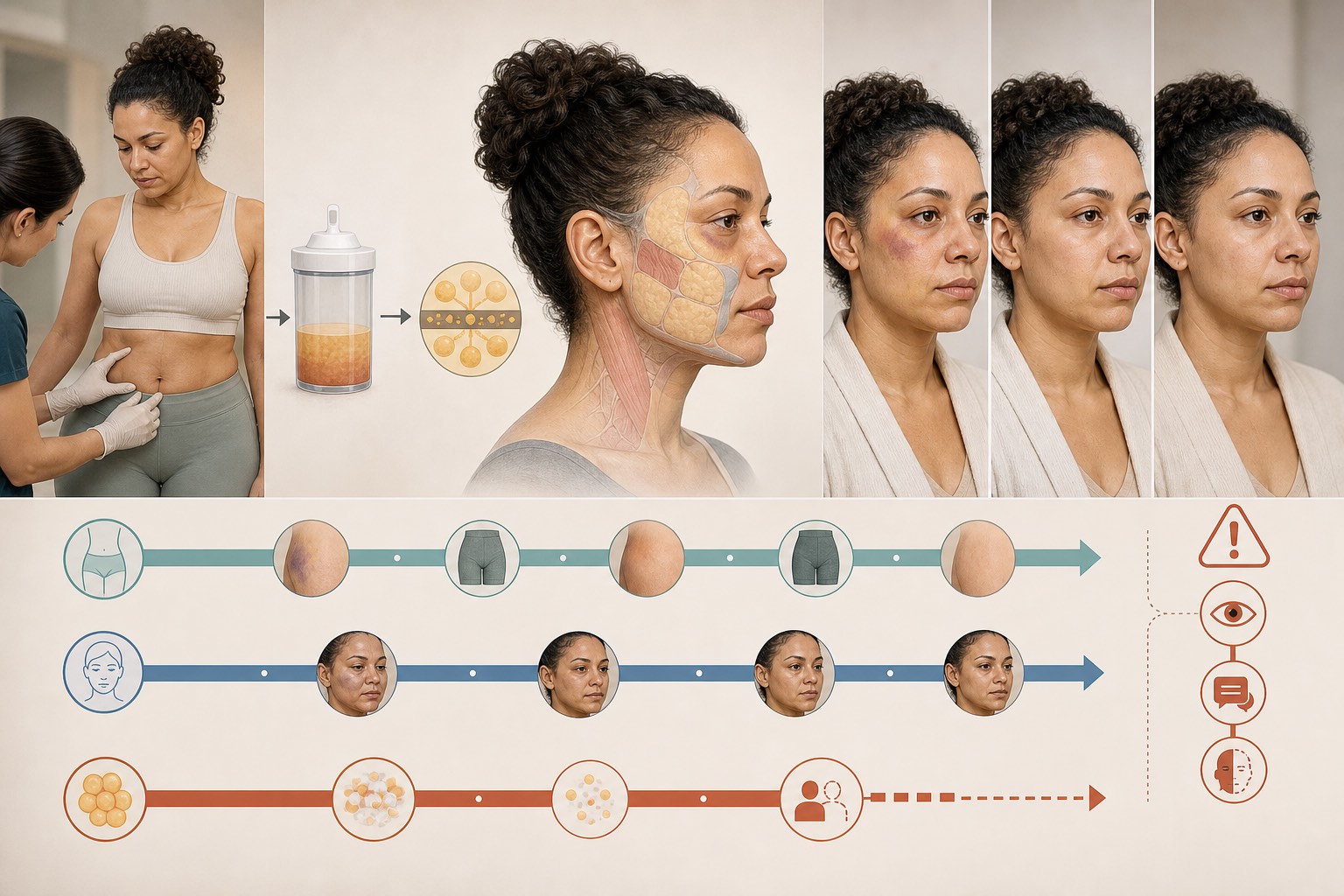
Why transferred fat creates three different clocks
Harvest creates a donor-site recovery involving small incisions, tissue disruption and procedure-specific compression or activity guidance. Processing prepares harvested tissue, and placement creates a separate facial response. One mirror check cannot represent both sites.
Early facial volume is a mixture of transferred tissue and postoperative edema. Some transferred cells establish a blood supply while some volume may not persist; technique, region, measurement and follow-up differ across studies, so no online retention percentage can forecast an individual result.
Fat is living tissue rather than a manufactured gel. Retained tissue may respond to later weight change and aging, and correcting excess or irregular grafted fat is not equivalent to dissolving hyaluronic-acid filler. The consultation must address reversibility and revision before treatment.
Deeper visual interpretation
Facial fat transfer is often described as one injection appointment, but the complete operation includes tissue harvest, processing and facial placement. Recovery therefore runs at two anatomical sites while visible swelling and biological retention follow different clocks.
| Track | What belongs here | What it cannot prove |
|---|---|---|
| Donor-site recovery | Incisions, bruising, soreness, swelling, garment and movement instructions | Facial graft retention or that a larger harvest improves the face |
| Facial visible recovery | Swelling, bruising, tenderness, firmness and standardized appearance | Stable volume, symmetry, survival percentage or final contour |
| Graft review | Later examination, photographs, contour, irregularity and discussion of retained effect | A universal month, permanent volume or an automatic second session |
| Emergency path | Sudden visual, neurological, severe-pain or ischemic skin symptoms | A stage to monitor at home or wait for swelling to settle |
| Question | Autologous facial fat | Hyaluronic-acid filler |
|---|---|---|
| Material and process | The patient's tissue is surgically harvested, processed and placed | A manufactured gel is injected from a product-specific syringe |
| Recovery sites | Donor and facial sites; anesthesia and combined surgery may matter | Primarily injection sites, though product and region alter recovery |
| Volume evolution | Early edema plus variable retained living tissue | Early edema plus product-specific integration and degradation |
| Reversibility | Excess or irregular retained fat is not dissolved like HA | Some HA fillers may be treated with hyaluronidase under clinical care; this is not risk-free or applicable to every filler |
| Shared boundary | Vascular compromise can cause tissue, visual or neurological injury | Vascular compromise can also cause tissue, visual or neurological injury |
Build a recovery record that does not confuse swelling with survival
- Map the full operation
List donor area, facial regions, anesthesia, facility, surgeon and every combined procedure before assigning a recovery date.
- Split the photographs
Document donor and facial sites separately with consistent conditions; keep pain, sensation, firmness and function in written fields.
- Use three review lanes
Track immediate safety, visible recovery and later contour as different questions rather than one progress score.
- Preserve the procedure record
Keep operative summary and treatment details for another clinician, especially after travel or if a later procedure is considered.
- Rehearse the emergency route
Know the local emergency number and visual or neurological warning signs before treatment; these do not wait for the clinic's next opening time.
How to interpret the stages
A recovery timeline combines broad observations from published patient guidance. It cannot know the exact product or device, treatment depth, technique, medical history, skin characteristics or aftercare plan involved in one person’s case.
Use the stages to understand the order in which changes may happen and to prepare questions for a qualified professional. Do not use a general internet timeline to override instructions from the clinician who assessed and treated you.
Aftercare principles
- Keep the operative record, donor and facial regions, volume by region if supplied, anesthesia, facility, surgeon contacts and every combined procedure. A facelift, eyelid surgery, resurfacing or larger liposuction changes recovery.
- Photograph face and donor area separately under consistent lighting, angle, expression, camera distance, clothing and time of day; record sensation, pain, firmness and function outside the image.
- Follow the surgeon's exact instructions for dressings, compression garments, sleep position, washing, work, driving, exercise, sun, makeup and travel. Do not import aftercare from dermal filler or another surgeon.
- Avoid smoking or nicotine and disclose medicines, supplements, previous fillers, facial surgery, bleeding risks and planned dental or medical procedures according to the treating team's instructions.
- Ask how the team distinguishes expected swelling from hematoma, infection, fat necrosis, cyst, irregularity, asymmetry, overgrowth or a vascular emergency—and who can assess both sites after hours or after travel.
Call emergency services immediately for sudden vision loss or change, severe eye pain, new one-sided weakness or numbness, facial droop, speech difficulty, confusion, severe sudden headache, collapse or another acute neurological symptom. Rapidly worsening severe pain, pale, mottled or dusky skin also needs immediate assessment. Contact the surgical team promptly for fever, spreading redness, pus, wound opening, heavy bleeding, rapidly enlarging swelling, breathing symptoms, persistent severe pain or worsening donor-site or facial change. Do not drive yourself when neurological or visual symptoms occur.
Why your timeline may differ
Questions to ask before treatment
- Which donor and facial regions, planes and combined procedures are planned?
- Who performs harvest, processing and every facial placement step, in what accredited facility?
- What are the separate instructions and review dates for donor and facial sites?
- How are expected swelling, irregularity, fat necrosis, infection and vascular warning signs distinguished?
- Who provides immediate emergency coordination and later revision care if treatment occurs abroad?
Who may harvest and inject fat, anesthesia rules, surgical-facility accreditation, professional titles and emergency systems differ by country. Verify the surgeon and facility in the treatment market and arrange local follow-up before medical travel; a cosmetic-injector credential alone does not establish authority to perform liposuction and surgery.
Find official checks for 12 marketsHow this guide was made
5 named sources support the main claims. Each link explains how it was used, with public agencies, professional bodies or primary research preferred.
AI may assist with research organization, drafting and translation, but it is not treated as a source or credential. Read the editorial standards.
Stage bars organize a relative sequence. Original editorial illustrations are conceptual and are not clinical measurements, outcome percentages or personal forecasts.
This version has editorial evidence review, not medical review attributed to a named clinician. It does not replace an individual assessment. Editorial accountability.
Sources
- Cleveland Clinic: Fat Transfer Surgery
Harvest, processing, recipient sites, general recovery, swelling, result review, risks and situations requiring medical contact.
- American Society of Plastic Surgeons: Fat Injections
Autologous harvest and facial grafting process, recovery context and possibility that multiple procedures may be needed.
- Systematic Review: Facial Fat Grafting Effectiveness and Complications
Heterogeneous retention methods, donor sites, follow-up and reported asymmetry, irregularity, prolonged edema, fat necrosis and other complications.
- Systematic Review: Complications of Aesthetic Facial Fat Grafting
Review of reported mild, transient, severe and permanent complications; case-based evidence cannot supply a personal event rate.
- Systematic Review and Meta-analysis: Ophthalmic Complications
Reported vascular and ophthalmic complications after facial autologous-fat injection, symptom patterns and serious vision-loss context.
Frequently asked questions
What should I know about Facial Fat Transfer Recovery?
Facial fat transfer has at least two recovery sites and three clocks. Fat is harvested from a donor area, processed and placed into selected facial tissue; early facial fullness therefore combines swelling with transferred fat, while the donor area may have separate bruising, soreness and compression instructions. Swelling and bruising can remain visible for weeks, but a stable retained volume cannot be read from an early photograph or predicted by one universal percentage. Longer review commonly extends across months, and another procedure may be discussed. Sudden vision change, severe eye pain, one-sided weakness, speech difficulty, severe headache or rapidly changing pale or dusky skin is an emergency—not normal settling.
Why can the timeline differ from person to person?
Treatment type, depth, technique, anatomy, skin and tissue response, health history, medication, aftercare and complications can all change timing. The treating professional’s instructions take priority over a general guide.
When should I contact a professional?
Call emergency services immediately for sudden vision loss or change, severe eye pain, new one-sided weakness or numbness, facial droop, speech difficulty, confusion, severe sudden headache, collapse or another acute neurological symptom. Rapidly worsening severe pain, pale, mottled or dusky skin also needs immediate assessment. Contact the surgical team promptly for fever, spreading redness, pus, wound opening, heavy bleeding, rapidly enlarging swelling, breathing symptoms, persistent severe pain or worsening donor-site or facial change. Do not drive yourself when neurological or visual symptoms occur.
Compare facial volume options without treating them as interchangeable
Keep surgical harvest and graft recovery separate from manufactured filler, facelift tissue repositioning and medication-related appearance questions.
Compare filler and muscle-relaxing treatment Read facelift recovery Read Ozempic face evidence Read Mounjaro face evidenceRelated beauty guides
View Plastic SurgeryRhinoplasty Aftercare: Sleeping, Glasses, Exercise and Nose Blowing
Rhinoplasty aftercare for sleep position, glasses, nose blowing, work and exercise—with source differences and surgeon-specific limits.
Read next PLASTIC SURGERYRhinoplasty vs Septoplasty: Appearance, Breathing, Recovery and Risks
Compare rhinoplasty and septoplasty by treatment goal, anatomy, breathing, recovery, risks and when both may be combined.
Read next PLASTIC SURGERYRhinoplasty Recovery Timeline: Week 1 to One Year
A broad rhinoplasty recovery timeline covering splints, early return, swelling and the long refinement period.
Read nextThis guide is for general education only. It is not medical advice, diagnosis, a treatment recommendation or a prediction of individual results. BeautiNext is not a clinic. Seek care from an appropriately qualified professional.