
JAWLINE · ILLUSTRATED 3D RECOVERY
Beard Transplant (Into a Scar): before & after and recovery stages
Follow a full short beard with a fictional hairless scar line through implantation into the scar, shedding and regrowth.
SUMMARY
What this example shows
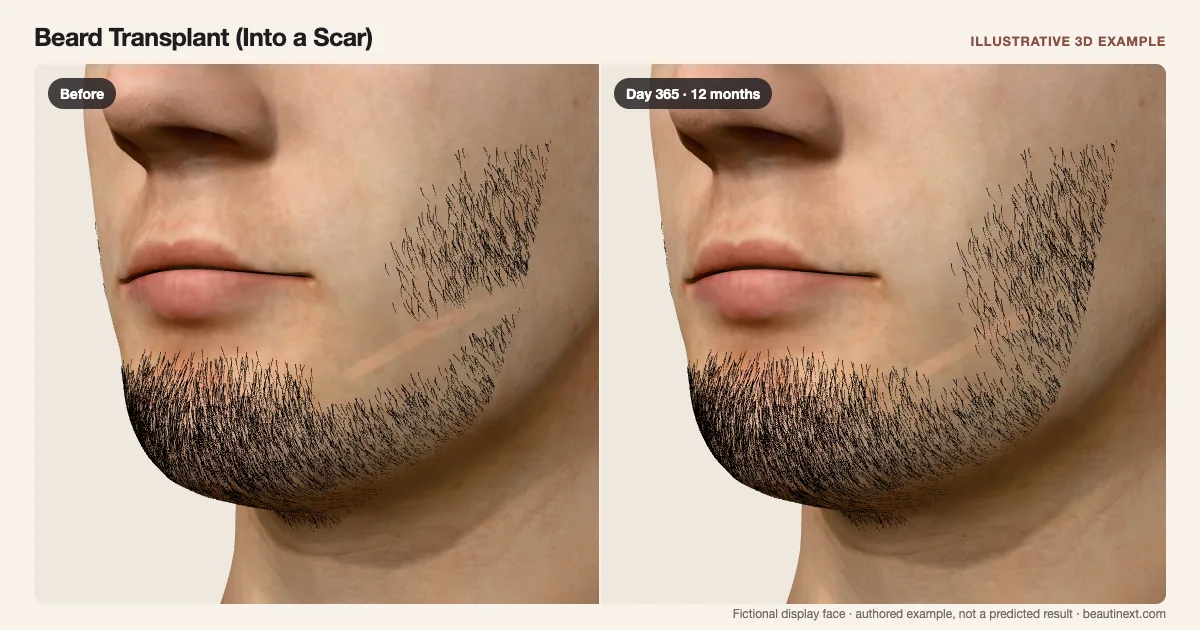
A fixed fictional linear scar crosses an otherwise full short beard on one cheek, leaving a hairless line. New shafts are placed only along that scar; existing beard hairs stay unchanged. The shafts shed and gradually regrow; scar tissue can hold fewer hairs, so a thinner line remains. Graft counts, scar blood supply, donor healing and personal density are not calculated.
STAGE BY STAGE
Beard Transplant (Into a Scar) recovery stages
Before treatment
The unchanged display face provides a reference for this example.
First day: Short shafts & surface marks
Small marks surround the added short hairs.
Scabs and temporary local swelling can occur in the recipient skin.
Around 2 months: Sparse interval
Many added shafts are no longer visible; native hairs remain.
Implanted shafts can shed before new growth appears.
Around 6 months: Growth developing
More and longer strands occupy the same recipient sites.
Regrowth develops over months, with individual variation.
Around 1 year: Later trimmed-hair example
The same area appears fuller in this short-hair illustration.
Later appearance depends on growth, direction and hair characteristics.
TIMELINE
Day-by-day checkpoints in the 3D model
The simulator interpolates between these authored checkpoints. They describe the illustration, not measured clinical averages.
The unchanged display face provides a reference for this example.
An authored facial-hair example; density and strand lengths are not individual forecasts.
An authored facial-hair example; density and strand lengths are not individual forecasts.
An authored facial-hair example; density and strand lengths are not individual forecasts.
An authored facial-hair example; density and strand lengths are not individual forecasts.
An authored facial-hair example; density and strand lengths are not individual forecasts.
An authored facial-hair example; density and strand lengths are not individual forecasts.
An authored facial-hair example; density and strand lengths are not individual forecasts.
An authored facial-hair example; density and strand lengths are not individual forecasts.
An authored facial-hair example; density and strand lengths are not individual forecasts.
An authored facial-hair example; density and strand lengths are not individual forecasts.
INDIVIDUAL DIFFERENCES
How recovery can vary
Timing and response
The scar line is a fixed illustrative reference; the surrounding beard stays unchanged. The reference hairs remain throughout; the visible strand numbers and lengths are authored, not a graft count or density forecast.
Longer term
Scar tissue can hold fewer grafts than normal skin, so a thinner line may remain and a second session may be considered. Compare up to 14 months; donor healing and graft counts are not reconstructed.
EVIDENCE NOTES
Sources and limitations
- ISHRS: Beard and mustache transplant
Facial recipient areas, shaft shedding and gradual regrowth over months; direction and donor availability matter.
- ISHRS: Understanding beard transplantation
Recipient scabs, individual recovery and differences in hair characteristics. Shaving instructions depend on the treating surgeon.
- Indian Journal of Plastic Surgery: Beard and moustache reconstruction
Temporary local redness and swelling; later growth, hair direction and variable reconstruction outcomes.
- BioMed Research International: Follicular unit transplantation into postsurgical scars · 2019
A small scalp-scar series reports most grafts surviving at 12 months, with a range below that of normal skin. It concerns scalp scars and does not calibrate this beard example.
KEEP COMPARING
Other jawline examples
- Calcium Hydroxylapatite Jawline Filler
- Ultrasound Tightening (Lower Face)
- Radiofrequency Tightening (Lower Face)
- Beard Transplant
- Upper-Jaw Surgery (Downward Movement)
- Upper-Jaw Surgery (Upward Movement)
- Upper-Jaw Surgery (Advancement)
- Lower-Jaw Surgery (Setback)
- Double Jaw Surgery (Upper Forward, Lower Back)
- Lower-Jaw Surgery (Advancement)
- Double-Jaw Surgery (Both Jaws Forward)
- Double-Jaw Surgery + Genioplasty (Combined)
- Jaw-Angle Implants
- Jaw-Angle Reduction
- Lower Facelift
- Jawline Filler
- Masseter Botox (Jaw-Slimming Injections)
This illustration is not medical advice, diagnosis, a treatment recommendation or a prediction of personal results. Swelling, color, contour and dates are authored examples on a fictional face. BeautiNext is not a clinic; your treating team’s assessment and written recovery plan take priority.