
JAWLINE · ILLUSTRATED 3D RECOVERY
Double Jaw Surgery (Upper Forward, Lower Back): before & after and recovery stages
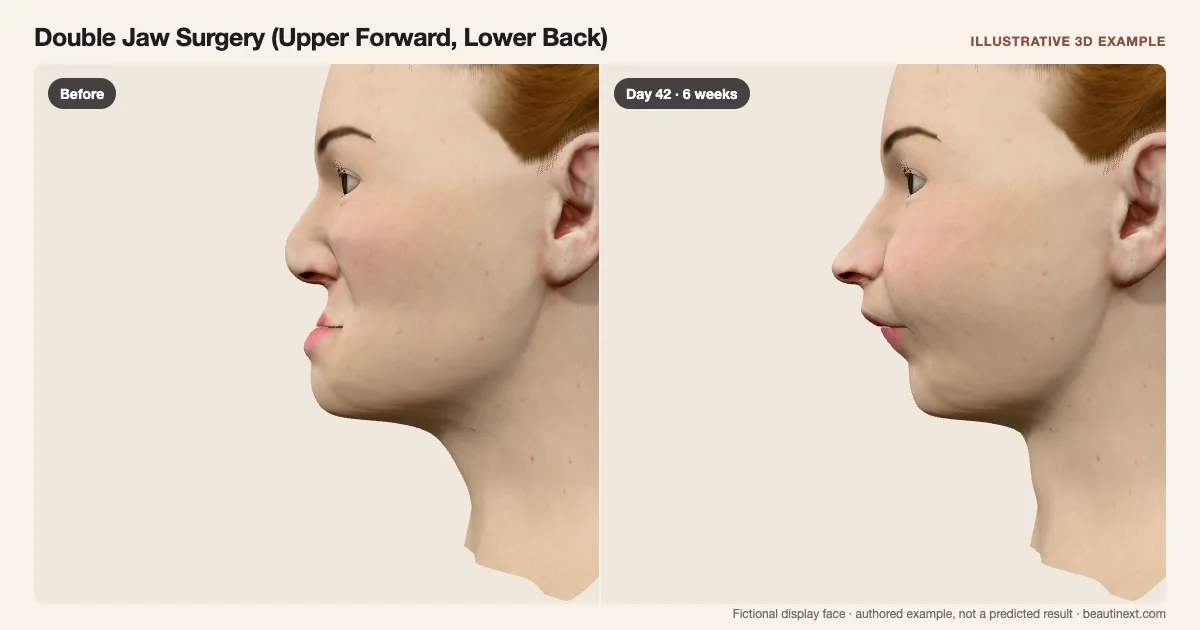
Compare one combined upper-jaw advancement and lower-jaw setback profile through early fullness and later soft-tissue settling.
Also called bimaxillary surgery · orthognathic surgery
SUMMARY
What this example shows
The same fictional profile combines upper-jaw advancement and lower-jaw setback. Early cheek and lip swelling masks both movements; later frames separate reduced fullness from the retained profile change. Other movements, rotations, asymmetry, braces, elastic bands and bite are not simulated. The contour slider is a display scale, not millimetres or a surgical plan.
STAGE BY STAGE
Double Jaw Surgery (Upper Forward, Lower Back) recovery stages
Before treatment
The unchanged display face provides a reference for this example.
First few days: Fullness obscures the profile
Cheek and lip swelling overlap the illustrated jaw movement.
Initial swelling is often prominent over the first few days.
Around 2 weeks: Less color, residual fullness
Bruising is lighter, while cheek and lip fullness still hides part of the contour.
Visible color and swelling can settle at different rates.
Around 6 weeks: Profile easier to compare
Less temporary fullness reveals the retained forward or backward movement.
A clearer outline does not establish normal sensation or bone healing.
Around 6 months: Later surface comparison
The same illustrated movement remains with little early swelling.
This is a comparison point, not a personal recovery deadline.
TIMELINE
Day-by-day checkpoints in the 3D model
The simulator interpolates between these authored checkpoints. They describe the illustration, not measured clinical averages.
The unchanged display face provides a reference for this example.
The changed profile is partly hidden by temporary swelling.
Broad cheek and lip fullness overlaps the jaw movement example.
Early swelling still obscures the underlying profile.
Color and fullness start easing at different rates.
Less discoloration reveals a profile that still has residual fullness.
Visible swelling is reduced, while subtle fullness remains.
The example contour is easier to compare; this does not show bone healing.
A small amount of illustrative fullness remains.
This display endpoint does not establish bite, sensation or bone union.
INDIVIDUAL DIFFERENCES
How recovery can vary
Timing and response
Both movements share one fictional starting face. Rotations, asymmetry, braces, elastics and dental bite are not represented; the slider scales appearance only.
Longer term
Jaw position, dental bite and sensation require separate follow-up. This outer surface cannot assess bone union or readiness for activity.
EVIDENCE NOTES
Sources and limitations
- Cambridge University Hospitals NHS: Upper-jaw osteotomy
Upper-jaw repositioning, facial swelling strongest around 48 hours, bruising over the first weeks and possible residual swelling for months. These phases do not calibrate the display offsets or dates.
- Cambridge University Hospitals NHS: Lower-jaw osteotomy
Lower-jaw repositioning with temporary facial fullness and bruising, limited mouth opening and a separate course for altered sensation. It does not predict a movement distance, bite or breathing outcome.
- Cambridge University Hospitals NHS: Corrective jaw surgery
Upper and lower jaw surgery changes the relationship of the jaws and commonly accompanies orthodontics. Swelling, bite adjustment and sensation are separate aspects of recovery.
KEEP COMPARING
Other jawline examples
- Calcium Hydroxylapatite Jawline Filler
- Ultrasound Tightening (Lower Face)
- Radiofrequency Tightening (Lower Face)
- Beard Transplant
- Beard Transplant (Into a Scar)
- Upper-Jaw Surgery (Downward Movement)
- Upper-Jaw Surgery (Upward Movement)
- Upper-Jaw Surgery (Advancement)
- Lower-Jaw Surgery (Setback)
- Lower-Jaw Surgery (Advancement)
- Double-Jaw Surgery (Both Jaws Forward)
- Double-Jaw Surgery + Genioplasty (Combined)
- Jaw-Angle Implants
- Jaw-Angle Reduction
- Lower Facelift
- Jawline Filler
- Masseter Botox (Jaw-Slimming Injections)
This illustration is not medical advice, diagnosis, a treatment recommendation or a prediction of personal results. Swelling, color, contour and dates are authored examples on a fictional face. BeautiNext is not a clinic; your treating team’s assessment and written recovery plan take priority.