
CHEEKS · ILLUSTRATED 3D RECOVERY
Cheekbone Reduction (Malarplasty): before & after and recovery stages
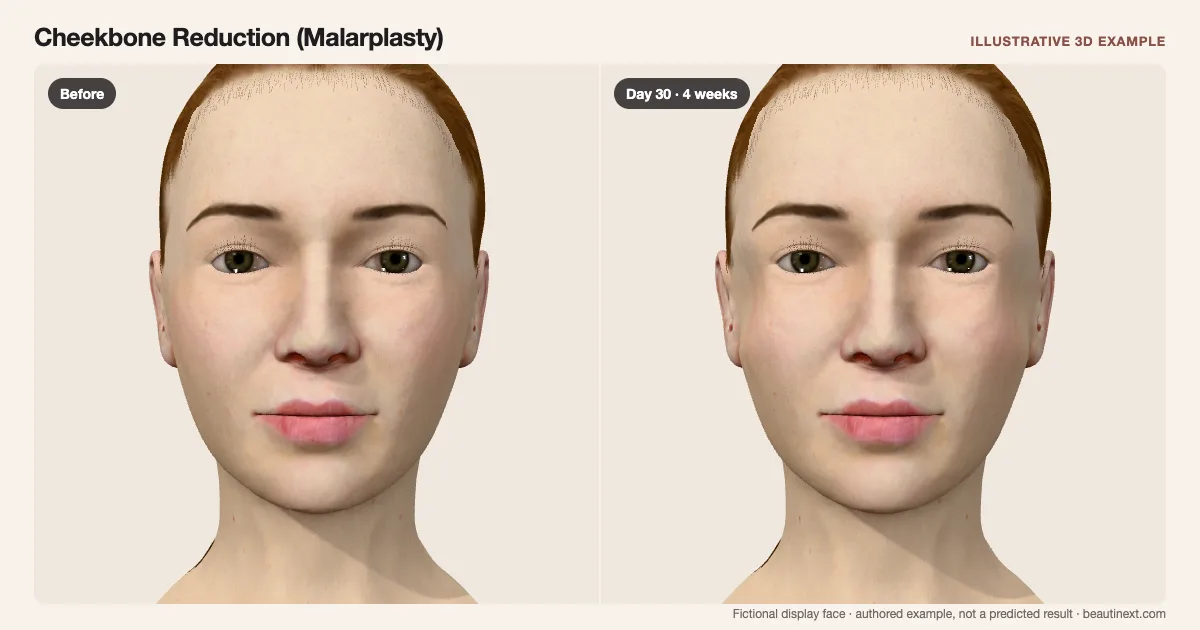
Compare upper-cheek width as early swelling gives way to a narrower malar outline.
SUMMARY
What this example shows
The upper outer-cheek contour narrows as an example of malar repositioning. The lower-cheek hollow and jaw are retained. Bone movement, skin support and surgical approach vary; this is not buccal fat removal or a measured bone-to-skin prediction.
STAGE BY STAGE
Cheekbone Reduction (Malarplasty) recovery stages
Before treatment
The unchanged display face provides a reference for this example.
First few days: Fullness masks the width
Temporary cheek swelling overlaps the smaller outline.
Postoperative swelling is described in combined facial-contouring reports.
Around 2 weeks: Early settling
Surface color fades while fullness remains.
These dates illustrate a course; combined-procedure reports do not set individual milestones.
Around 1 month: Midface comparison
Less fullness reveals the narrower upper cheeks.
Published bone movements cannot directly predict the visible skin change.
Around 3 months: Later width example
The upper-cheek outline is easier to compare.
Soft-tissue response requires separate assessment from bone width.
TIMELINE
Day-by-day checkpoints in the 3D model
The simulator interpolates between these authored checkpoints. They describe the illustration, not measured clinical averages.
The unchanged display face provides a reference for this example.
Swelling overlaps the narrowed upper-cheek contour.
Temporary cheek fullness partly conceals the new width.
The local swelling begins easing in this example.
Less surface color reveals more of the outline.
The outer upper cheeks are narrower with residual fullness.
The surface has less early fullness.
The example does not predict soft-tissue sagging, symmetry or bone union.
INDIVIDUAL DIFFERENCES
How recovery can vary
Timing and response
This changes the upper outer-cheek contour, retaining the lower-cheek hollow and jaw. It does not represent buccal fat removal.
Longer term
Surgical approach and skin support affect settling. The final frame does not predict sagging, symmetry or bone union.
EVIDENCE NOTES
Sources and limitations
- Journal of Craniofacial Surgery: Malar arch movement study
A CT study of inward malar movement. The authors call for further soft-tissue analysis; bone measurements do not calibrate this surface animation.
- Annals of Translational Medicine: Combined facial contouring case series
Postoperative swelling in a small combined jaw/malar surgery series. It cannot establish an isolated-procedure or individual recovery clock.
KEEP COMPARING
Other cheeks examples
This illustration is not medical advice, diagnosis, a treatment recommendation or a prediction of personal results. Swelling, color, contour and dates are authored examples on a fictional face. BeautiNext is not a clinic; your treating team’s assessment and written recovery plan take priority.