
EARS · ILLUSTRATED 3D RECOVERY
Stretched Earlobe Repair (Gauge Hole): before & after and recovery stages
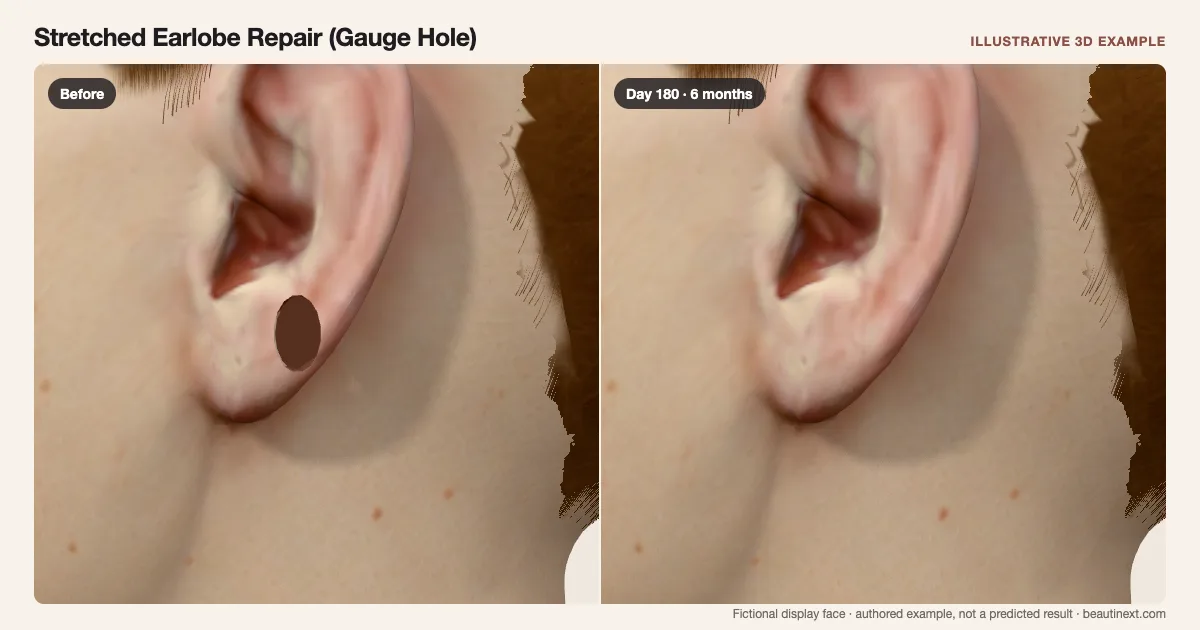
Compare a fictional stretched gauge opening with a longer closed line and its fading scar.
SUMMARY
What this example shows
A fixed fictional stretched gauge opening, much larger than a small enlarged piercing, sits in the lower earlobe with a thin intact rim. Repair closes the opening with a longer vertical line; early stitches, swelling and color fade separately from a residual scar. Excess-tissue trimming, flap design, lobe size after repair and re-piercing timing are not calculated.
STAGE BY STAGE
Stretched Earlobe Repair (Gauge Hole) recovery stages
Stretched opening reference
The same fictional large opening with a thin lower rim provides the reference.
Gauge size and remaining tissue vary; this is one example size.
First few days: Closure with stitches
A longer closed line, stitches and local swelling replace the opening.
Larger openings often need trimming or flap techniques; the example shows one closed line.
Around 1 month: Residual scar
Stitches are gone; the closed line remains visible.
Scar color and lobe shape keep settling over months.
Around 6 months: Later closure comparison
A faint line remains on the closed lobe.
Re-piercing timing and lobe size after repair are not assessed.
TIMELINE
Day-by-day checkpoints in the 3D model
The simulator interpolates between these authored checkpoints. They describe the illustration, not measured clinical averages.
The same fictional large opening with a thin lower rim provides the reference.
A longer closed line replaces the stretched opening beneath local swelling.
Stitches and temporary swelling overlap the closed lobe.
Color and fullness ease independently of the closure.
Stitches are hidden at an authored comparison point, not a removal instruction.
The opening stays closed with a visible line.
A residual line remains along the closure.
The closed lobe retains a faint scar; re-piercing is not assessed.
INDIVIDUAL DIFFERENCES
How recovery can vary
Timing and response
Opening size, remaining rim thickness and repair technique vary. Tissue trimming, flaps and the final lobe shape are not reconstructed.
Longer term
The final frame does not predict scar quality, symmetry with the other ear or whether a later revision is needed.
EVIDENCE NOTES
Sources and limitations
- Journal of Cutaneous and Aesthetic Surgery: Repair of gauged earlobes · 2021 case series
Describes closing gauged earlobes with techniques chosen by opening size. It does not calibrate this viewer's opening, line length or dates.
- Plastic and Reconstructive Surgery – Global Open: Repair of massive earlobe piercing and plugs · 2014
Reports repair of very large gauge openings with tissue rearrangement. It does not set healing dates for this example.
KEEP COMPARING
Other ears examples
This illustration is not medical advice, diagnosis, a treatment recommendation or a prediction of personal results. Swelling, color, contour and dates are authored examples on a fictional face. BeautiNext is not a clinic; your treating team’s assessment and written recovery plan take priority.