
NOSE · ILLUSTRATED 3D RECOVERY
Alar Base Reduction (Nostril Width): before & after and recovery stages
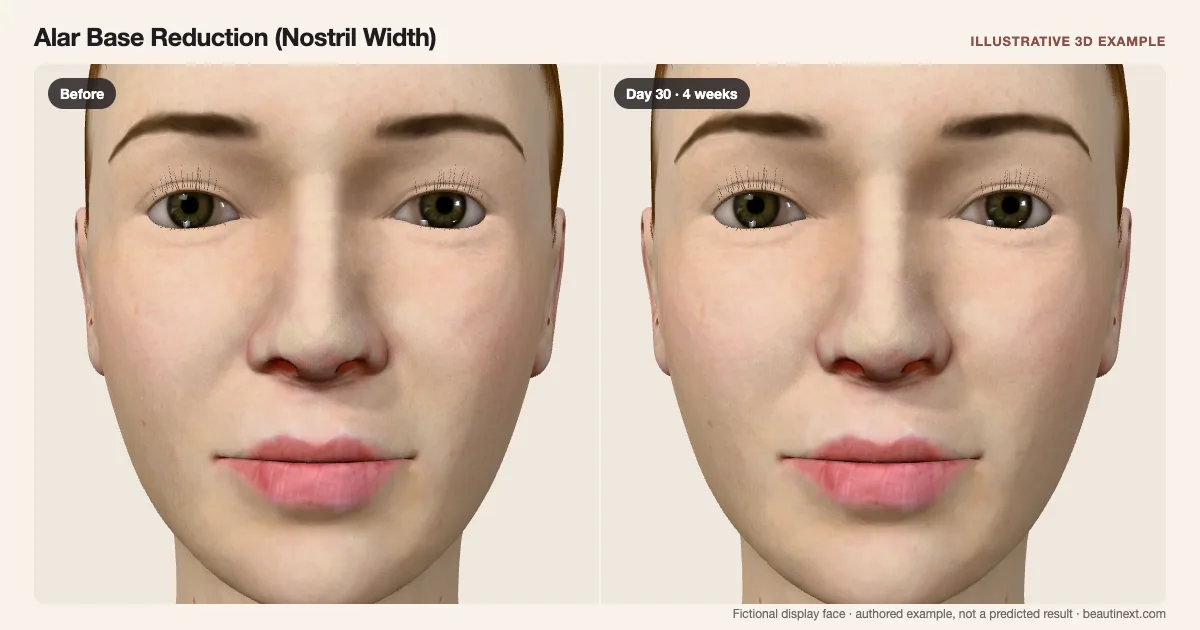
Follow local nostril-base fullness as a narrower outer outline becomes visible.
SUMMARY
What this example shows
The outer nostril wings move inward while the bridge and central tip remain in place. Early local fullness partly obscures the smaller base. Incision shape, nostril opening and airflow are not reconstructed.
STAGE BY STAGE
Alar Base Reduction (Nostril Width) recovery stages
Before treatment
The unchanged display face provides a reference for this example.
First few days: Local fullness
Temporary swelling surrounds the narrowed base.
This local response is illustrated using broad nasal-surgery guidance, not an isolated alar recovery study.
Around 2 weeks: Outline emerging
Less surface color reveals the nostril wings.
The bridge and central tip stay in place in this example.
Around 1 month: Base-width comparison
The outer base is narrower, with less temporary fullness.
Published techniques differ in their incision and tissue changes.
Around 3 months: Later base example
The contour is easier to compare.
A smooth rendered surface does not mean a scar will be invisible.
TIMELINE
Day-by-day checkpoints in the 3D model
The simulator interpolates between these authored checkpoints. They describe the illustration, not measured clinical averages.
The unchanged display face provides a reference for this example.
Fullness overlaps the narrowed nostril base.
Color and puffiness are localized around the outer nostrils.
Temporary fullness starts to recede in this example.
Less surface color reveals the base outline.
The model shows narrower alar wings with residual fullness.
The skin outline does not show incision or scar quality.
Scars and individual nostril symmetry are not predicted.
INDIVIDUAL DIFFERENCES
How recovery can vary
Timing and response
Nostril shape, incisions and combined surgery affect recovery. The view does not model airflow, an internal opening or scar placement.
Longer term
Incision appearance and nostril symmetry require individual assessment. These dates do not establish an isolated alar-surgery healing deadline.
EVIDENCE NOTES
Sources and limitations
- Otolaryngology–Head and Neck Surgery: Nasal base narrowing study
A case series of alar base narrowing. It supports the direction of change, not the displayed recovery curve or an individual amount of reduction.
- Cleveland Clinic: Cosmetic nose surgery
Separate bridge, tip and nostril changes; tip swelling can persist after earlier visible improvement.
- Journal of Oral and Maxillofacial Surgery: Alar base scar outcomes
A retrospective comparison of scar outcomes with different alar incisions. Scars are not reconstructed by this viewer.
KEEP COMPARING
Other nose examples
- Rhinoplasty
- Revision Rhinoplasty (Tip Deviation)
- Thread Lift (Nose Tip)
- Revision Rhinoplasty (Saddle Dorsum)
- Revision Rhinoplasty (Over-Rotated Tip)
- Revision Rhinoplasty (Alar Retraction)
- Structural Rhinoplasty (Tip Support)
- Nasal Tip Refinement
- Dorsal Hump Reduction
- Nasal Osteotomy (Bridge Narrowing)
- Nasal Bridge Augmentation (Surgery)
- Nonsurgical Rhinoplasty (Filler)
- Bunny Line Botox (Anti-Wrinkle Injections)
This illustration is not medical advice, diagnosis, a treatment recommendation or a prediction of personal results. Swelling, color, contour and dates are authored examples on a fictional face. BeautiNext is not a clinic; your treating team’s assessment and written recovery plan take priority.