
NOSE · ILLUSTRATED 3D RECOVERY
Revision Rhinoplasty (Tip Deviation): before & after and recovery stages
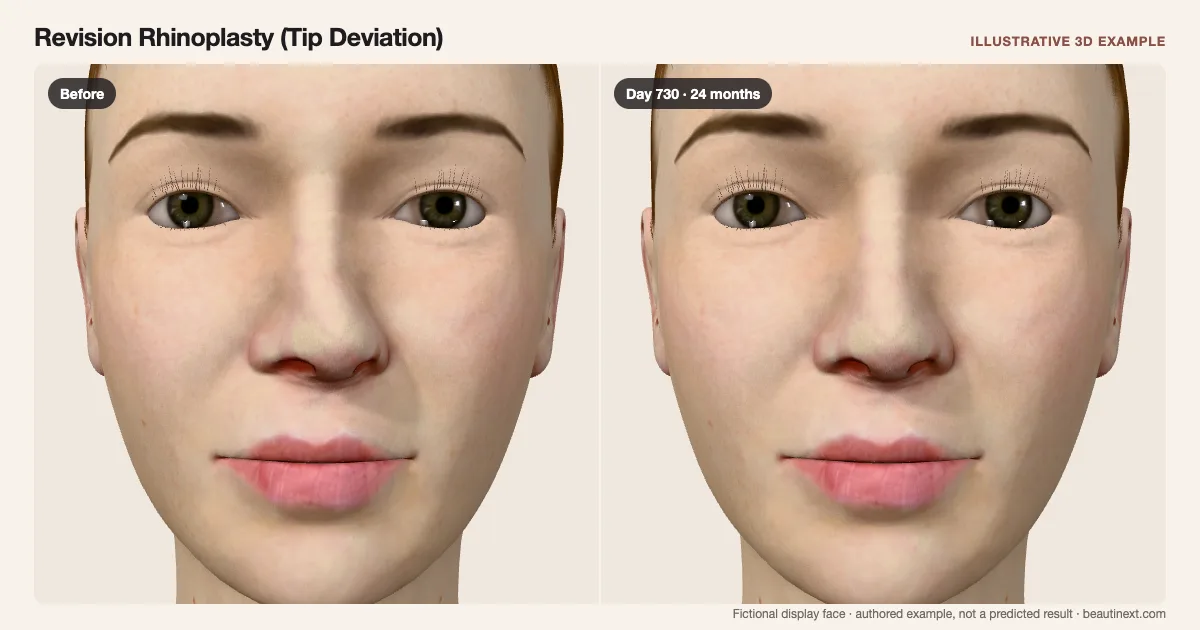
Compare a fixed fictional tip deviation with partial recentering through early swelling and longer settling.
SUMMARY
What this example shows
A fixed fictional tip deviation supplies the reference after a previous operation. The same tip surface moves partly back toward the center, with residual deviation retained. Early fullness and under-eye color settle separately. This is one external revision example; prior scar tissue, internal cartilage, graft choice, donor sites, the airway and open or closed incisions are not reconstructed.
STAGE BY STAGE
Revision Rhinoplasty (Tip Deviation) recovery stages
Deviated tip reference
The same fictional off-center tip stays beneath every stage.
This is one revision scenario, not a diagnosis or a reconstruction of the prior operation.
First few days: Fullness over the correction
An optional splint, tip fullness and under-eye color overlap the partially recentered outline.
The example hides its splint at day 7; your surgical team sets the actual support plan.
Around 6 months: Intermediate outline
The tip sits closer to the center with residual deviation and fullness.
Previous scar tissue and reconstructive work can affect the later contour.
Around 2 years: Longer surface comparison
The same partial correction remains with little temporary fullness.
Nasal settling can continue over one or two years; this comparison does not establish a personal endpoint.
TIMELINE
Day-by-day checkpoints in the 3D model
The simulator interpolates between these authored checkpoints. They describe the illustration, not measured clinical averages.
The same fictional off-center tip stays beneath every stage.
Partial recentering is present beneath early nasal fullness.
Tip fullness and under-eye color partly hide the recentered outline.
The optional example splint is hidden while fullness remains.
Color eases before the tip fullness.
The same partial recentering remains beneath residual fullness.
The tip still has some temporary fullness in this authored course.
Less fullness makes the retained deviation easier to compare.
A small amount of example fullness remains.
Residual deviation is retained; this endpoint is not a promised completion date.
INDIVIDUAL DIFFERENCES
How recovery can vary
Timing and response
This example recenters only a fictional tip deviation. Prior scar tissue, bridge reconstruction, cartilage grafts, donor recovery, airway function and open or closed incisions are not reconstructed.
Longer term
Residual deviation stays visible. The surface does not predict graft stability, scar recurrence, breathing or whether another revision is needed.
EVIDENCE NOTES
Sources and limitations
- ASPS: Revision rhinoplasty and structural reconstruction
Describes existing scar tissue and cartilage support in revision surgery. It does not calibrate the illustrated tip deviation or promise symmetry.
- ASPS: What to expect during rhinoplasty recovery
External dressings commonly worn for the first week, under-eye bruising and later gradual change.
- ASPS: Rhinoplasty recovery and longer settling
Discusses one-to-two-year settling and variation with grafts and surgical approach. The authored two-year display is not a revision-specific deadline.
KEEP COMPARING
Other nose examples
- Rhinoplasty
- Alar Base Reduction (Nostril Width)
- Thread Lift (Nose Tip)
- Revision Rhinoplasty (Saddle Dorsum)
- Revision Rhinoplasty (Over-Rotated Tip)
- Revision Rhinoplasty (Alar Retraction)
- Structural Rhinoplasty (Tip Support)
- Nasal Tip Refinement
- Dorsal Hump Reduction
- Nasal Osteotomy (Bridge Narrowing)
- Nasal Bridge Augmentation (Surgery)
- Nonsurgical Rhinoplasty (Filler)
- Bunny Line Botox (Anti-Wrinkle Injections)
This illustration is not medical advice, diagnosis, a treatment recommendation or a prediction of personal results. Swelling, color, contour and dates are authored examples on a fictional face. BeautiNext is not a clinic; your treating team’s assessment and written recovery plan take priority.