
NOSE · ILLUSTRATED 3D RECOVERY
Nasal Osteotomy (Bridge Narrowing): before & after and recovery stages
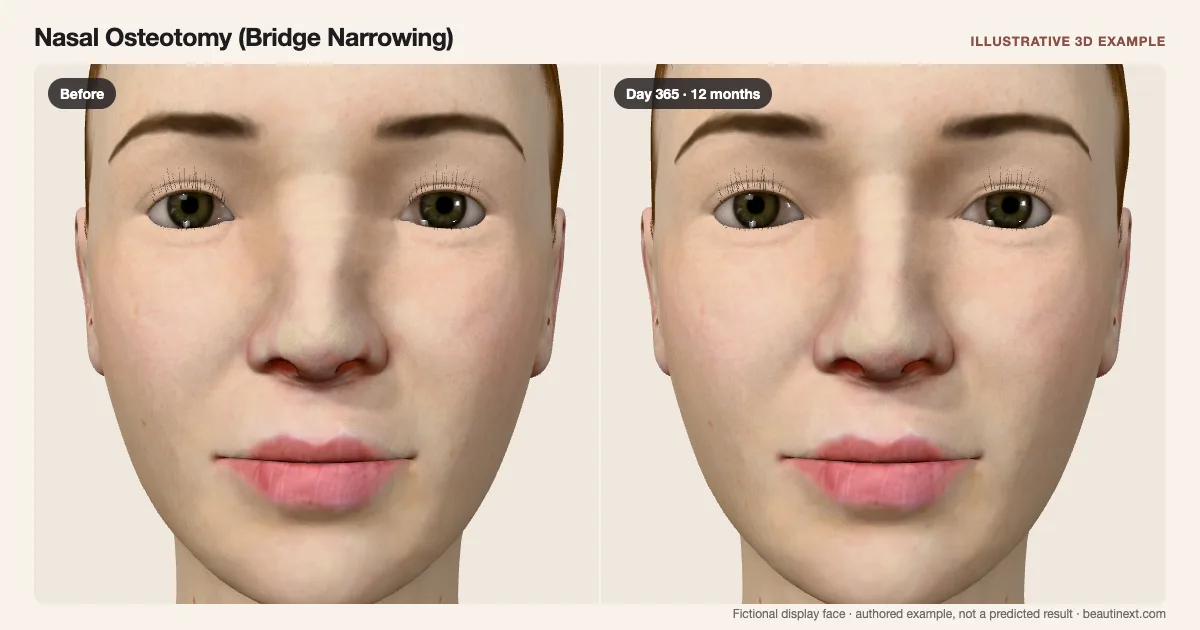
Compare upper-bridge width as early swelling and under-eye color settle.
SUMMARY
What this example shows
A fixed fictional wide upper bridge provides the reference. Its sides move inward while early nasal fullness and under-eye bruising settle separately. Later bridge height, tip position and nostril-base width stay fixed. This external example does not reconstruct bone cuts, union, airway function or a specific instrument.
STAGE BY STAGE
Nasal Osteotomy (Bridge Narrowing) recovery stages
Wide upper-bridge reference
The same fictional wide upper bridge underlies every stage.
This starting width is authored, not inferred from the selected regional face.
First few days: Width change under swelling
Early fullness overlaps the inward movement; under-eye bruising remains visible.
An optional splint covers the bridge. Hide it to inspect the same skin.
Around 1 month: Narrower bridge emerging
Less swelling reveals a narrower upper bridge while the tip and nostril base stay fixed.
The example retains some fullness after its early color fades.
Around 1 year: Later width comparison
The upper bridge remains partly narrower than the fixed starting contour.
A settled surface does not establish bone union or airway function.
TIMELINE
Day-by-day checkpoints in the 3D model
The simulator interpolates between these authored checkpoints. They describe the illustration, not measured clinical averages.
The same fictional wide upper bridge underlies every stage.
Early fullness overlaps the narrowed upper bridge.
Nasal swelling and under-eye bruising mask the width change.
The example splint is hidden; temporary width remains.
Color settles faster than the remaining nasal fullness.
The upper bridge is narrower with residual fullness.
The width change is easier to compare.
A small amount of illustrative fullness remains.
The narrowed surface does not establish bone healing or breathing function.
INDIVIDUAL DIFFERENCES
How recovery can vary
Timing and response
The bone work, starting anatomy and combined operations affect recovery. This isolated width example preserves later bridge height, tip position and alar width; no cut pattern or instrument is selected.
Longer term
Subtle nasal changes can continue for months. These comparison dates do not predict individual healing, breathing or the need for revision.
EVIDENCE NOTES
Sources and limitations
- JAMA Facial Plastic Surgery: Nasal osteotomy and early swelling/bruising
The trial describes lateral osteotomies and evaluates periorbital edema and ecchymosis on days 2 and 7. It does not calibrate this surface movement, color or timeline.
- ASPS: Rhinoplasty recovery
Early swelling, splints and longer-term refinement.
KEEP COMPARING
Other nose examples
- Rhinoplasty
- Alar Base Reduction (Nostril Width)
- Revision Rhinoplasty (Tip Deviation)
- Thread Lift (Nose Tip)
- Revision Rhinoplasty (Saddle Dorsum)
- Revision Rhinoplasty (Over-Rotated Tip)
- Revision Rhinoplasty (Alar Retraction)
- Structural Rhinoplasty (Tip Support)
- Nasal Tip Refinement
- Dorsal Hump Reduction
- Nasal Bridge Augmentation (Surgery)
- Nonsurgical Rhinoplasty (Filler)
- Bunny Line Botox (Anti-Wrinkle Injections)
This illustration is not medical advice, diagnosis, a treatment recommendation or a prediction of personal results. Swelling, color, contour and dates are authored examples on a fictional face. BeautiNext is not a clinic; your treating team’s assessment and written recovery plan take priority.