
EYELIDS · ILLUSTRATED 3D RECOVERY
Eyelid Revision (Asymmetric Crease): before & after and recovery stages
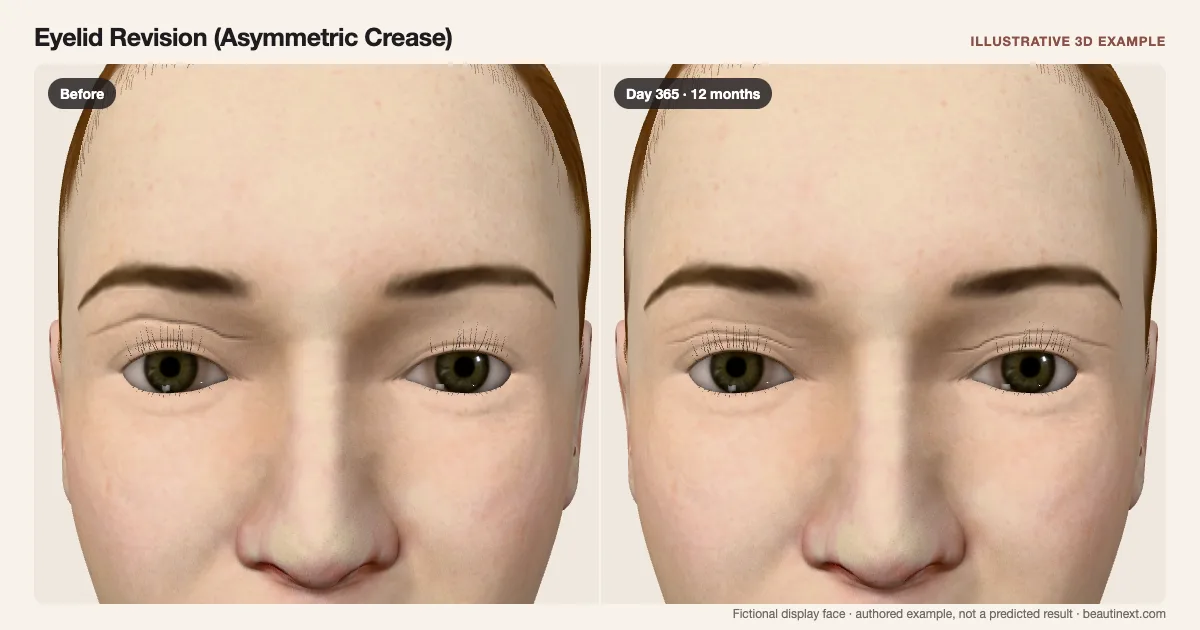
Compare one high reference crease with a lowered fold on that eye while the other eye keeps its native lid.
SUMMARY
What this example shows
A fixed fictional high crease on one eye supplies an asymmetric reference while the other eye keeps its native lid. Only that crease is softened and a lower fold defined to bring the two sides closer. Early swelling and closure marks appear on the revised side alone, and a faint trace of the old line remains. Fold heights and symmetry are authored examples, not measurements or a guarantee of matching eyes.
STAGE BY STAGE
Eyelid Revision (Asymmetric Crease) recovery stages
Asymmetric reference
A fictional high fold on one eye provides the same starting asymmetry at every stage.
This is an added reference condition, not a diagnosis of the selected face.
First few days: Swelling on one side
A lower closed line, early stitches and fullness appear on the revised eye only.
One-sided swelling can make the eyes look more different at first; the example hides stitches from day 7.
Around 1 month: Sides becoming closer
Less fullness reveals the lower fold while a trace of the old line remains.
Settling continues after visible bruising eases.
Around 1 year: Closer, not identical
The two lids look more alike with faint residual traces on the revised side.
Natural faces are not perfectly symmetric; this view does not promise matching eyes.
TIMELINE
Day-by-day checkpoints in the 3D model
The simulator interpolates between these authored checkpoints. They describe the illustration, not measured clinical averages.
A fictional high fold on one eye provides the same starting asymmetry at every stage.
A lower closed incision accompanies temporary fullness; the old high fold is partly softened.
Upper-lid puffiness and color partly obscure the lower fold.
External stitches are hidden in this example; the incision and old crease trace remain.
Fullness eases while both the old trace and lower line remain visible.
Reduced swelling reveals a lower crease beneath the softened old line.
The lower fold remains while the closure line becomes less prominent.
Both a faint old crease and lower incision remain in this illustration.
A lower crease and residual old trace remain; this does not promise an erased scar or lasting symmetry.
INDIVIDUAL DIFFERENCES
How recovery can vary
Timing and response
Only one high crease is lowered. Eyelid-margin height, brows and the other eye are held fixed; ptosis, skin shortage and multiple folds are not reproduced.
Longer term
Asymmetry is the most common reason for dissatisfaction after double-eyelid surgery. The final frame does not predict symmetry, scarring or the need for further revision.
EVIDENCE NOTES
Sources and limitations
- Journal of Cosmetic Dermatology: A 7-year analysis of complaints after Asian blepharoplasty · 2025
Asymmetry, mostly of crease height, was the most frequent complaint after primary and revision double-eyelid surgery. It does not calibrate this viewer's fold heights or dates.
- Sungkyunkwan University · study abstract: Lowering of the high eyelid crease in revision upper eyelid surgery
The authors' institutional abstract describes high-crease lowering and separately assesses crease and lid-margin position. It does not provide this illustration's daily recovery, fold coordinates or scar fading. Full article figures were not reviewed.
- NHS: Eyelid surgery
Puffy eyelids, bruising, suture strips and scar settling.
- Cambridge University Hospitals NHS: Blepharoplasty and stitches
Upper-lid incision in the natural crease, fine stitches and usual removal at a one-week clinic visit. The displayed path and fading intensity are illustrative.
KEEP COMPARING
Other eyelids examples
- Subbrow Lift (Upper-Lid Skin)
- Upper Blepharoplasty
- Eyelid Revision (Lowering a High Crease)
- Double Eyelid Surgery
- Partial-Incision Double Eyelid Surgery
- Buried-Suture Double Eyelid Surgery
- Ptosis Repair (Upper-Lid Height)
- Epicanthal Fold Restoration
- Epicanthoplasty (Inner Corner)
- Lateral Canthopexy (Lower-Lid Support)
- Lateral Canthoplasty (Outer Corner)
- Lower-Lid Fat Repositioning
- Lower Blepharoplasty
- Under-Eye Fat Transfer
- Tear-Trough Filler
- Crow’s Feet Botox (Anti-Wrinkle Injections)
This illustration is not medical advice, diagnosis, a treatment recommendation or a prediction of personal results. Swelling, color, contour and dates are authored examples on a fictional face. BeautiNext is not a clinic; your treating team’s assessment and written recovery plan take priority.