
EYELIDS · ILLUSTRATED 3D RECOVERY
Under-Eye Fat Transfer: before & after and recovery stages
Compare under-eye volume before transfer, through early fullness and later settling.
SUMMARY
What this example shows
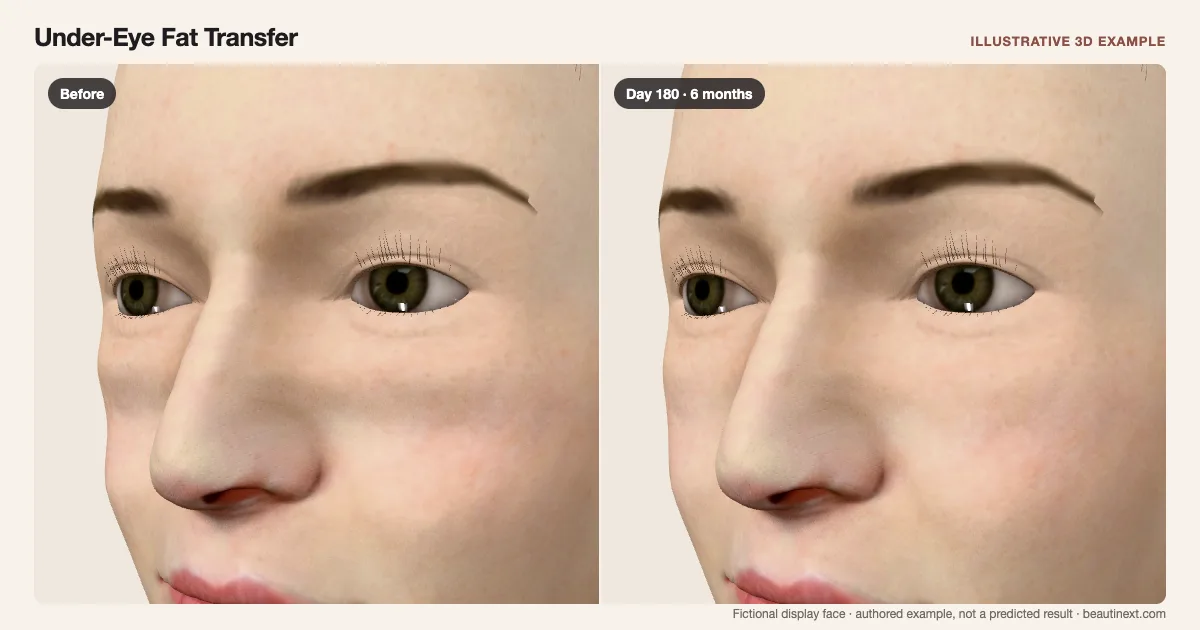
A fixed fictional hollow beneath each eye provides the reference for a broad, shallow volume addition. Early fullness and bruising fade separately from a smaller later volume. The eye opening and upper lid stay fixed. This is transferred fat, not repositioning an existing eye bag; pigment, donor healing and fat survival are not predicted.
STAGE BY STAGE
Under-Eye Fat Transfer recovery stages
Starting contour
Fixed fictional hollows define the starting volume.
The same reference is used at every date and does not diagnose the selected face.
First few days: Volume plus swelling
Temporary fullness and color overlap the added volume.
Recipient swelling and bruising can affect early appearance.
Around 1 month: Fullness easing
Less surface color exposes the evolving contour.
Early appearance is not a measure of retained fat.
Around 6 months: Later volume example
A smaller, smoother addition remains after the temporary response.
Settling and fat retention vary; this date is a comparison point.
TIMELINE
Day-by-day checkpoints in the 3D model
The simulator interpolates between these authored checkpoints. They describe the illustration, not measured clinical averages.
The unchanged display face provides a reference for this example.
Added volume overlaps swelling and local color.
Temporary fullness obscures the underlying volume change.
The local response starts easing in this example.
Less discoloration makes the contour easier to compare.
Remaining fullness is distinct from the later volume example.
The illustrated contour becomes less full over months.
Residual volume remains; its size does not measure fat survival.
This stable display endpoint does not predict aging or future volume.
INDIVIDUAL DIFFERENCES
How recovery can vary
Timing and response
Transferred amount, technique and healing affect the course. This surface example omits donor recovery and does not predict fat survival or pigment changes.
Longer term
The one-year view holds the later contour for comparison. Aging, weight changes, irregularities and repeat treatment are not forecast.
EVIDENCE NOTES
Sources and limitations
- Cleveland Clinic: Under-eye fat transfer
Transfer into under-eye hollows, early puffiness and volume settling over months. This does not calibrate the model's volume or fat survival.
- Cleveland Clinic: Fat transfer
Temporary swelling and bruising; volume assessment over several months.
KEEP COMPARING
Other eyelids examples
- Subbrow Lift (Upper-Lid Skin)
- Upper Blepharoplasty
- Eyelid Revision (Lowering a High Crease)
- Eyelid Revision (Asymmetric Crease)
- Double Eyelid Surgery
- Partial-Incision Double Eyelid Surgery
- Buried-Suture Double Eyelid Surgery
- Ptosis Repair (Upper-Lid Height)
- Epicanthal Fold Restoration
- Epicanthoplasty (Inner Corner)
- Lateral Canthopexy (Lower-Lid Support)
- Lateral Canthoplasty (Outer Corner)
- Lower-Lid Fat Repositioning
- Lower Blepharoplasty
- Tear-Trough Filler
- Crow’s Feet Botox (Anti-Wrinkle Injections)
This illustration is not medical advice, diagnosis, a treatment recommendation or a prediction of personal results. Swelling, color, contour and dates are authored examples on a fictional face. BeautiNext is not a clinic; your treating team’s assessment and written recovery plan take priority.