
EYELIDS · ILLUSTRATED 3D RECOVERY
Upper Blepharoplasty: before & after and recovery stages
Compare upper-eyelid puffiness and discoloration with the slower settling of the incision area.
Also called upper eyelid surgery · upper eyelid lift
SUMMARY
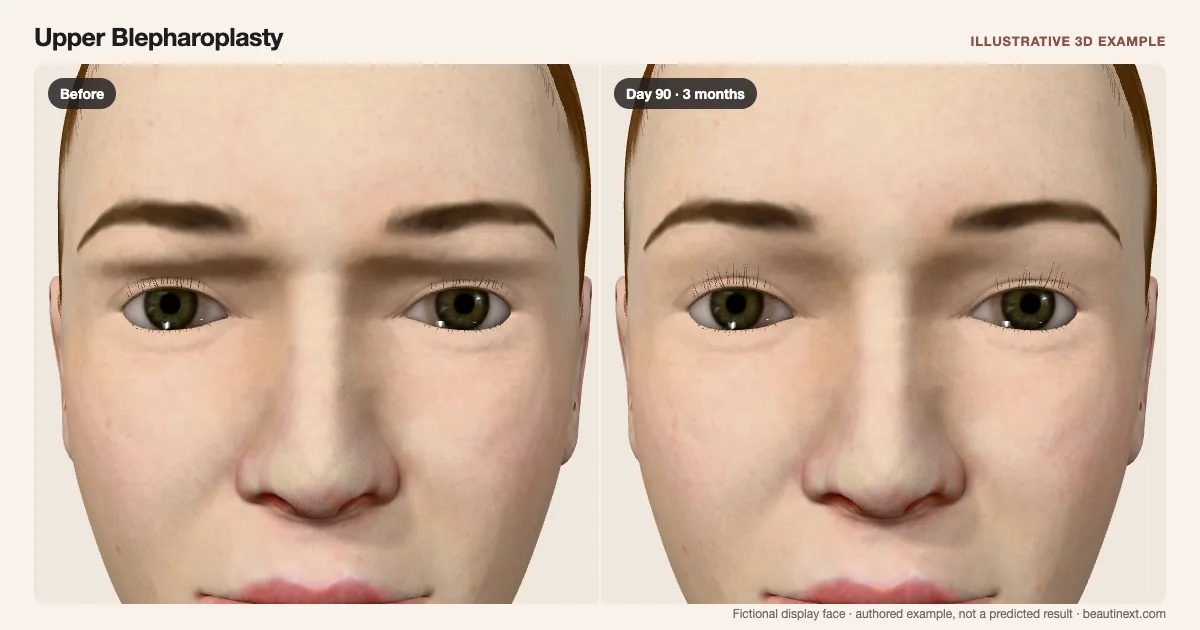
What this example shows
A fixed fictional excess-skin fold above the upper lid provides the reference. Its surface bulk is partly reduced as separate swelling and bruising settle. The lid margin and eyeball remain fixed; this does not simulate ptosis repair, tissue excision or eyelid closure function.
STAGE BY STAGE
Upper Blepharoplasty recovery stages
Upper-lid skin reference
The reference retains the same fictional skin fold above the opening.
The lid margin and eyeball stay fixed in this skin-reduction example.
First few days: Early incision response
Swelling and bruising overlap the reduced skin fold and closed incision.
Stitch marks are shown before day 7; the closed line remains after they disappear.
Around 1 month: Beyond the bruising
Early discoloration has eased while a finer incision line remains.
Scars may remain visible or feel tight for months; this model does not forecast your scar.
Around 3 months: Later fold and incision
The fold is partly reduced and a faint closed incision line remains.
Scar appearance and tightness can keep changing; this is not a personal completion date.
TIMELINE
Day-by-day checkpoints in the 3D model
The simulator interpolates between these authored checkpoints. They describe the illustration, not measured clinical averages.
The fictional excess-skin fold above the upper lid stays beneath every recovery stage. The lid margin and eyeball are fixed.
The eyelid surface is fuller around the fixed eye opening.
Both upper and lower eye-area swelling and discoloration are illustrated.
Bruising changes color while eyelid fullness begins to ease.
Less swelling makes the example upper-lid contour easier to see.
Appearance and comfort can recover on different clocks.
Subtle scar and tissue changes can outlast the visible response. The date is a visual checkpoint, not clearance.
INDIVIDUAL DIFFERENCES
How recovery can vary
Timing and response
Upper and lower eyelid procedures have different incisions and tissue changes. Your technique, eye symptoms and healing history matter more than a matching display face.
Longer term
The example line fades further toward three months. Scar appearance can keep changing, and less swelling does not establish scar maturity or how the incision feels.
EVIDENCE NOTES
Sources and limitations
- NHS: Eyelid surgery
Puffy eyelids, bruising, suture strips and scar settling.
- Cambridge University Hospitals NHS: Blepharoplasty and stitches
Upper-lid incision in the natural crease, fine stitches and usual removal at a one-week clinic visit. The displayed path and fading intensity are illustrative.
KEEP COMPARING
Other eyelids examples
- Subbrow Lift (Upper-Lid Skin)
- Eyelid Revision (Lowering a High Crease)
- Eyelid Revision (Asymmetric Crease)
- Double Eyelid Surgery
- Partial-Incision Double Eyelid Surgery
- Buried-Suture Double Eyelid Surgery
- Ptosis Repair (Upper-Lid Height)
- Epicanthal Fold Restoration
- Epicanthoplasty (Inner Corner)
- Lateral Canthopexy (Lower-Lid Support)
- Lateral Canthoplasty (Outer Corner)
- Lower-Lid Fat Repositioning
- Lower Blepharoplasty
- Under-Eye Fat Transfer
- Tear-Trough Filler
- Crow’s Feet Botox (Anti-Wrinkle Injections)
This illustration is not medical advice, diagnosis, a treatment recommendation or a prediction of personal results. Swelling, color, contour and dates are authored examples on a fictional face. BeautiNext is not a clinic; your treating team’s assessment and written recovery plan take priority.