
EYELIDS · ILLUSTRATED 3D RECOVERY
Lower-Lid Fat Repositioning: before & after and recovery stages
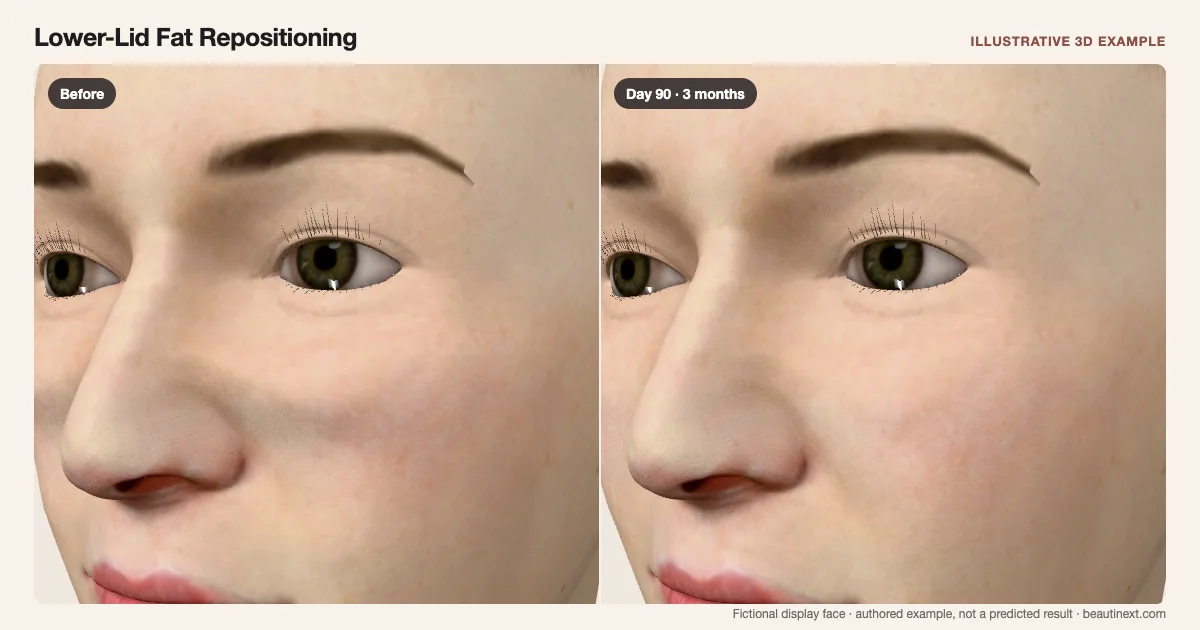
Compare the eye bag and the hollow beneath it as early swelling settles.
SUMMARY
What this example shows
An authored under-eye bulge becomes smaller while the hollow beneath it becomes shallower. Early swelling temporarily obscures this paired contour change. The same starting contour stays beneath every stage. This illustrates repositioning existing orbital fat; internal tissue movement, skin removal and personal results are not reconstructed.
STAGE BY STAGE
Lower-Lid Fat Repositioning recovery stages
Bulge and hollow
This reference has a fictional under-eye bulge and adjacent hollow.
Existing orbital fat can be repositioned to soften this transition.
First few days: Swelling masks the change
Temporary fullness and bruising cover the underlying contour.
Puffiness and discoloration can occur after lower-lid surgery.
Around 2 weeks: Two changes emerge
The bulge is smaller and the hollow shallower as swelling eases.
Visible bruising may last several weeks; this date is illustrative.
Around 3 months: Later contour comparison
A smoother transition remains, with some starting contour retained.
The source supports the mechanism, not this endpoint or degree of correction.
TIMELINE
Day-by-day checkpoints in the 3D model
The simulator interpolates between these authored checkpoints. They describe the illustration, not measured clinical averages.
This reference has a fictional under-eye bulge and adjacent hollow.
Temporary swelling overlaps the paired contour change.
The under-eye region is fuller and discolored in this example.
The illustrated swelling and bruising begin to ease.
The bulge and hollow become easier to compare.
A small amount of example fullness remains.
Partial smoothing of the starting bulge and hollow remains.
INDIVIDUAL DIFFERENCES
How recovery can vary
Timing and response
The starting contour is fictional. Skin laxity, lid support, technique and healing differ between people. The preview shows surface shape, without reconstructing internal fat movement or predicting pigmentation changes.
Longer term
Later appearance and durability vary. This comparison does not determine how much tissue to move or whether surgery is suitable.
EVIDENCE NOTES
Sources and limitations
- AAO EyeWiki: Tear trough and fat repositioning
Explains moving existing orbital fat to address a bulge and adjacent hollow. Surface offsets and dates are authored examples.
- NHS: Eyelid surgery
Puffy eyelids, bruising, suture strips and scar settling.
KEEP COMPARING
Other eyelids examples
- Subbrow Lift (Upper-Lid Skin)
- Upper Blepharoplasty
- Eyelid Revision (Lowering a High Crease)
- Eyelid Revision (Asymmetric Crease)
- Double Eyelid Surgery
- Partial-Incision Double Eyelid Surgery
- Buried-Suture Double Eyelid Surgery
- Ptosis Repair (Upper-Lid Height)
- Epicanthal Fold Restoration
- Epicanthoplasty (Inner Corner)
- Lateral Canthopexy (Lower-Lid Support)
- Lateral Canthoplasty (Outer Corner)
- Lower Blepharoplasty
- Under-Eye Fat Transfer
- Tear-Trough Filler
- Crow’s Feet Botox (Anti-Wrinkle Injections)
This illustration is not medical advice, diagnosis, a treatment recommendation or a prediction of personal results. Swelling, color, contour and dates are authored examples on a fictional face. BeautiNext is not a clinic; your treating team’s assessment and written recovery plan take priority.