
SKIN & SCARS · ILLUSTRATED 3D RECOVERY
Cryotherapy (Small Raised Scars): before & after and recovery stages
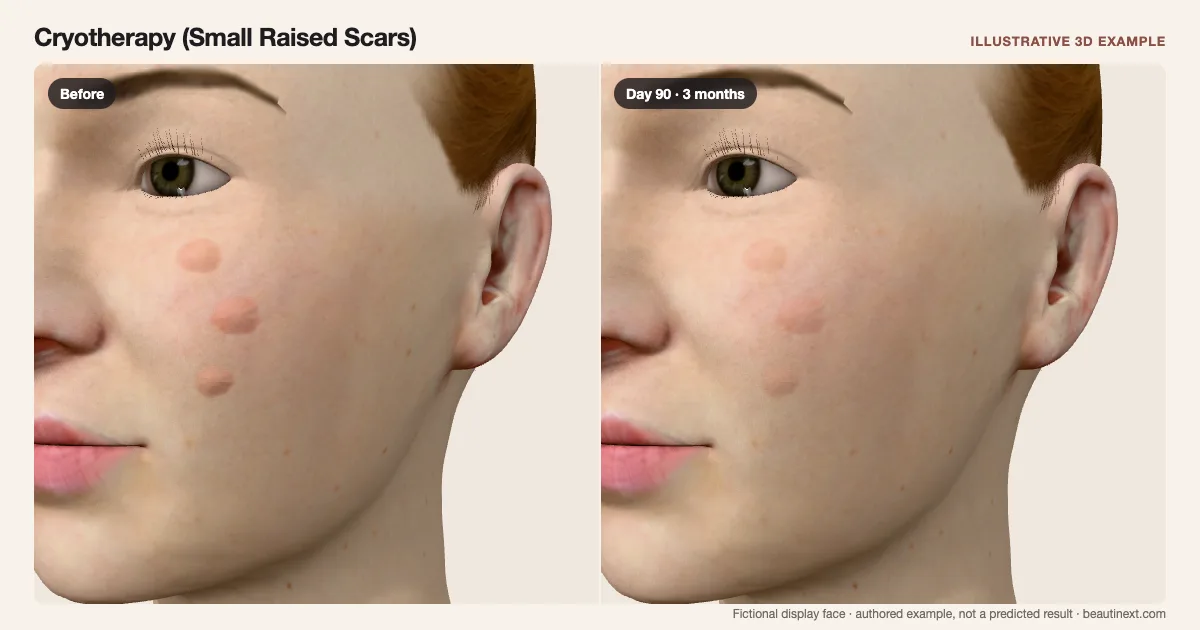
Compare small raised scars, an early freezing response, localized crusts and a partly flatter later example.
SUMMARY
What this example shows
Three fixed raised scars per cheek develop local fullness and color, then a small crust layer before a partly flatter later example. The footprint stays fixed and residual relief remains. This surface illustration does not reconstruct freezing technique, blisters, open wounds, permanent pigment change or a personal response to one session.
STAGE BY STAGE
Cryotherapy (Small Raised Scars) recovery stages
Raised-scar reference
Three small elevations occupy fixed sites on each cheek.
Fictional scars provide the comparison; their shape does not diagnose a scar type.
Early response: Local fullness and color
The same raised sites become temporarily fuller and redder.
Swelling and blisters can occur after freezing. Blister fluid and open wounds are omitted here.
Surface reaction: Small crusted sites
Brown crusts cover the same marks as early fullness eases.
Crusts and healing times vary; the displayed week is a comparison point.
Later comparison: Residual raised texture
The same marks retain less height and some visible color.
Partial flattening is illustrative; it is not a one-session result or a clearance rate.
TIMELINE
Day-by-day checkpoints in the 3D model
The simulator interpolates between these authored checkpoints. They describe the illustration, not measured clinical averages.
Three small elevations occupy fixed sites on each cheek.
Temporary fullness and color surround the original raised sites.
A local crust layer covers the same raised scars.
Crusts remain while the initial fullness eases.
The original sites reappear beneath a smaller crust layer.
The example crust layer has cleared; some raised texture and color remain.
Residual raised tissue is easier to compare after the early surface reaction.
Partly flatter marks remain at the same sites; this is not a clearance prediction.
A stable display endpoint does not predict recurrence or pigment change.
INDIVIDUAL DIFFERENCES
How recovery can vary
Timing and response
Scar size, technique and response affect the course. The view does not select freezing settings or plan repeated treatments.
Longer term
Lighter or darker pigment can persist after freezing. This view does not predict pigment loss, new scarring or recurrence; a flatter mark does not establish treatment suitability.
EVIDENCE NOTES
Sources and limitations
- AAD: Freezing raised scars
Cryosurgery can reduce raised scar tissue. It does not calibrate this example's height, dates or treatment count.
- Leeds Teaching Hospitals NHS: Cryotherapy recovery
General skin-freezing guidance describes swelling, possible blistering and crusts, variable healing and potentially persistent lighter or darker pigment. It is not a scar-specific response curve.
KEEP COMPARING
Other skin & scars examples
- Z-Plasty (Scar Reorientation)
- Scar Revision Surgery
- Mole Removal (Shave)
- Mole Removal (Excision)
- Microdermabrasion
- Dermabrasion
- Light Chemical Peel
- Medium Chemical Peel
- Deep Chemical Peel
- Ablative Laser Resurfacing
- Nonablative Laser Resurfacing
- Microneedling (Without RF)
- Radiofrequency Microneedling
- IPL (Brown-Spot Response)
- Laser Toning (Melasma)
- Skin Booster Injections
- TCA CROSS (Ice-Pick Scars)
- Punch Elevation (Boxcar Scars)
- Punch Skin Grafting (Acne Scars)
- Punch Excision (Acne Scars)
- Keloid Excision
- Steroid Injections (Keloid)
- Steroid Injections (Raised Acne Scars)
- Subcision (Rolling Cheek Scars)
- Pulsed Dye Laser (Cheek Redness)
This illustration is not medical advice, diagnosis, a treatment recommendation or a prediction of personal results. Swelling, color, contour and dates are authored examples on a fictional face. BeautiNext is not a clinic; your treating team’s assessment and written recovery plan take priority.