
SKIN & SCARS · ILLUSTRATED 3D RECOVERY
Radiofrequency Microneedling: before & after and recovery stages
Separate early RF pinpoint marks and color from later partial softening of the same example texture.
SUMMARY
What this example shows
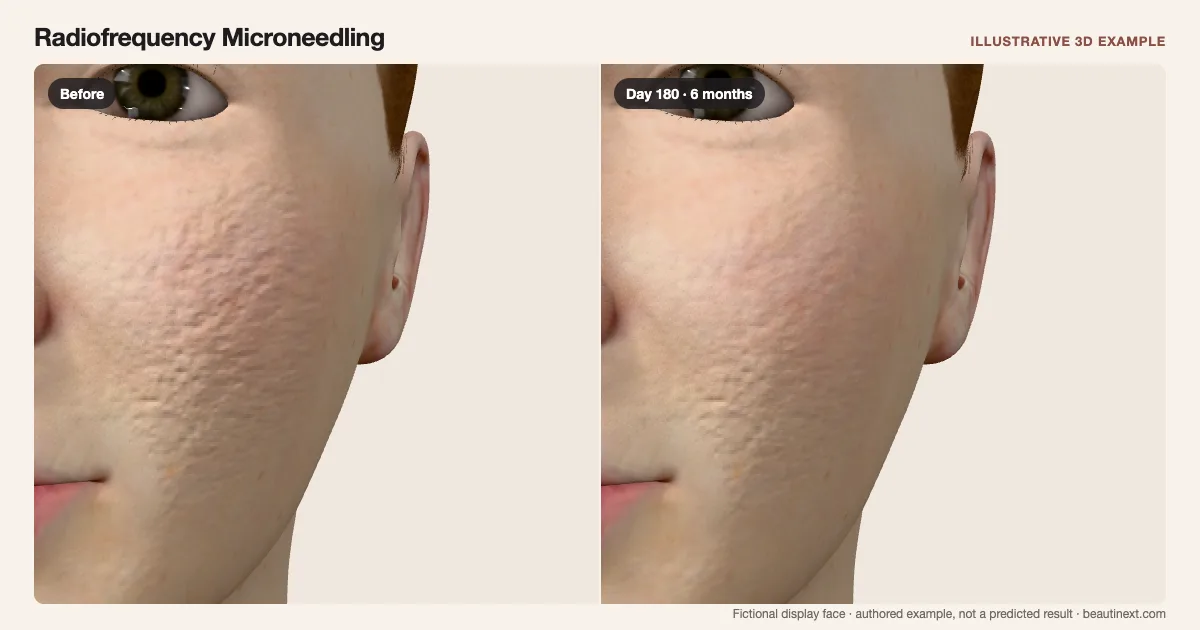
Early color and pinpoint marks fade before gradual softening of fictional texture and fine lines. RF energy is delivered through needles beneath the skin; this surface view preserves natural pores and facial contour. Dates and smoothing strength are illustrative, not an efficacy comparison, session plan, heat calculation or prediction of tightening, scar correction or complications.
STAGE BY STAGE
Radiofrequency Microneedling recovery stages
Starting texture
The same fictional coarse texture and fine lines provide a fixed reference.
This surface example does not reconstruct deeper tissue or select device settings.
First hours: Pinpoint response
Small marks and surface color overlap the unchanged starting texture.
Pinpoint bleeding can occur. The dots illustrate a reaction, not needle placement.
Around 1 week: Marks settle before texture
Early marks and color have mostly faded; the starting texture remains.
A quiet-looking surface does not show deeper effects or rule out injury.
Around 6 months: Softer, residual texture
The treated area's coarse texture and fine lines are partly softer; natural pores remain.
The source discusses results over three to six months within a treatment plan. The example does not set session counts or improvement rates.
TIMELINE
Day-by-day checkpoints in the 3D model
The simulator interpolates between these authored checkpoints. They describe the illustration, not measured clinical averages.
The same fictional coarse texture and fine lines provide a fixed reference.
Small illustrated marks accompany surface color over the starting texture.
Redness and punctate marks remain in this example.
The fixed marks fade without moving across the skin.
The early reaction is small while the starting texture remains.
Pinpoint marks have faded before the later texture example develops.
A small texture difference follows the early surface response.
The same fine lines and coarse texture are partly softer.
Natural pores and residual texture remain. The display does not rank treatment effectiveness.
INDIVIDUAL DIFFERENCES
How recovery can vary
Timing and response
Device, depth, energy and skin response matter. The FDA reports serious complications with certain uses, including burns, scars, fat loss and nerve injury. These are not simulated.
Longer term
Residual texture remains. This authored surface change does not rank RF against conventional needling or predict tightening, scar correction, pigmentation, lasting benefit or complications.
EVIDENCE NOTES
Sources and limitations
- Cleveland Clinic: RF microneedling
RF delivery through needles, early redness and possible pinpoint bleeding, and gradual texture results over three to six months within a treatment plan. Display strengths are not measured outcomes.
- FDA: RF microneedling safety communication
Reports of serious complications with certain uses; device-specific assessment and trained care.
KEEP COMPARING
Other skin & scars examples
- Z-Plasty (Scar Reorientation)
- Scar Revision Surgery
- Mole Removal (Shave)
- Mole Removal (Excision)
- Microdermabrasion
- Dermabrasion
- Light Chemical Peel
- Medium Chemical Peel
- Deep Chemical Peel
- Ablative Laser Resurfacing
- Nonablative Laser Resurfacing
- Microneedling (Without RF)
- IPL (Brown-Spot Response)
- Laser Toning (Melasma)
- Skin Booster Injections
- TCA CROSS (Ice-Pick Scars)
- Punch Elevation (Boxcar Scars)
- Punch Skin Grafting (Acne Scars)
- Punch Excision (Acne Scars)
- Cryotherapy (Small Raised Scars)
- Keloid Excision
- Steroid Injections (Keloid)
- Steroid Injections (Raised Acne Scars)
- Subcision (Rolling Cheek Scars)
- Pulsed Dye Laser (Cheek Redness)
This illustration is not medical advice, diagnosis, a treatment recommendation or a prediction of personal results. Swelling, color, contour and dates are authored examples on a fictional face. BeautiNext is not a clinic; your treating team’s assessment and written recovery plan take priority.