
SKIN & SCARS · ILLUSTRATED 3D RECOVERY
Laser Toning (Melasma): before & after and recovery stages
Compare the same fictional melasma patches through a series of low-energy sessions, partial lightening and possible return.
SUMMARY
What this example shows
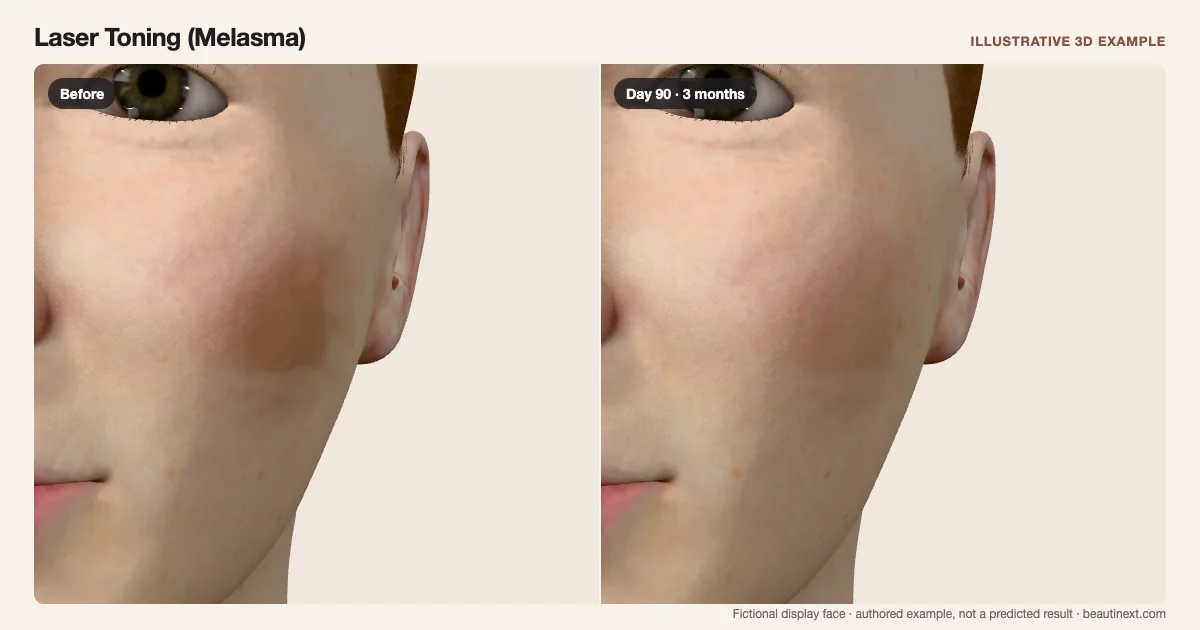
Fixed fictional melasma patches on the cheeks stay at the same sites. Over a series of low-energy sessions, the treated patches become partly lighter while brief redness fades. A later checkpoint shows partial return, because melasma commonly recurs. Device settings, session count, topical care and personal clearance are not calculated.
STAGE BY STAGE
Laser Toning (Melasma) recovery stages
Melasma reference
The same fictional patches on both cheeks provide a fixed reference.
This display pattern is not a diagnosis; other pigment conditions need different care.
Around 1 month: Gradual lightening
After several example sessions the treated patches are slightly lighter.
Session number and interval depend on the device, skin type and response.
Around 3 months: Series comparison
The patches are partly lighter and still visible at the same sites.
Lasers can speed fading but do not cure melasma.
Around 6 months: Possible partial return
Some color returns in this example.
Recurrence is common; sun protection and topical care affect it. This is not a prediction.
TIMELINE
Day-by-day checkpoints in the 3D model
The simulator interpolates between these authored checkpoints. They describe the illustration, not measured clinical averages.
The unchanged display face provides a reference for this example.
Mild color overlaps the same patches after an example session.
Redness has faded; the patches are much as before.
After several example sessions the treated patches are slightly lighter.
The same patches are lighter but still visible.
Partial lightening; residual patches remain at the same sites.
Some color returns in this example; recurrence is common and not predicted here.
INDIVIDUAL DIFFERENCES
How recovery can vary
Timing and response
Melasma depth, skin type, hormones, sun exposure and device settings vary widely. Mottled lightening or darkening can occur and is not simulated.
Longer term
The final frame does not predict clearance, recurrence timing or the need for maintenance sessions.
EVIDENCE NOTES
Sources and limitations
- Journal of Cosmetic Dermatology: Low-fluence Q-switched Nd:YAG laser for melasma · 2018
A retrospective series reports partial melasma improvement over repeated low-fluence sessions, with occasional mottled hypopigmentation and rebound. It does not calibrate this viewer's patch color, dates or session count.
- International Journal of Women's Dermatology: A review of laser and light therapy in melasma · 2017
Describes lasers as an adjunct for resistant melasma, not a cure, with risks of post-inflammatory darkening and frequent recurrence.
- AAD: Melasma: diagnosis and treatment
Sun protection and topical care remain central; procedures can help some patients and melasma often returns. It does not set a laser schedule.
KEEP COMPARING
Other skin & scars examples
- Z-Plasty (Scar Reorientation)
- Scar Revision Surgery
- Mole Removal (Shave)
- Mole Removal (Excision)
- Microdermabrasion
- Dermabrasion
- Light Chemical Peel
- Medium Chemical Peel
- Deep Chemical Peel
- Ablative Laser Resurfacing
- Nonablative Laser Resurfacing
- Microneedling (Without RF)
- Radiofrequency Microneedling
- IPL (Brown-Spot Response)
- Skin Booster Injections
- TCA CROSS (Ice-Pick Scars)
- Punch Elevation (Boxcar Scars)
- Punch Skin Grafting (Acne Scars)
- Punch Excision (Acne Scars)
- Cryotherapy (Small Raised Scars)
- Keloid Excision
- Steroid Injections (Keloid)
- Steroid Injections (Raised Acne Scars)
- Subcision (Rolling Cheek Scars)
- Pulsed Dye Laser (Cheek Redness)
This illustration is not medical advice, diagnosis, a treatment recommendation or a prediction of personal results. Swelling, color, contour and dates are authored examples on a fictional face. BeautiNext is not a clinic; your treating team’s assessment and written recovery plan take priority.