
SKIN & SCARS · ILLUSTRATED 3D RECOVERY
Subcision (Rolling Cheek Scars): before & after and recovery stages
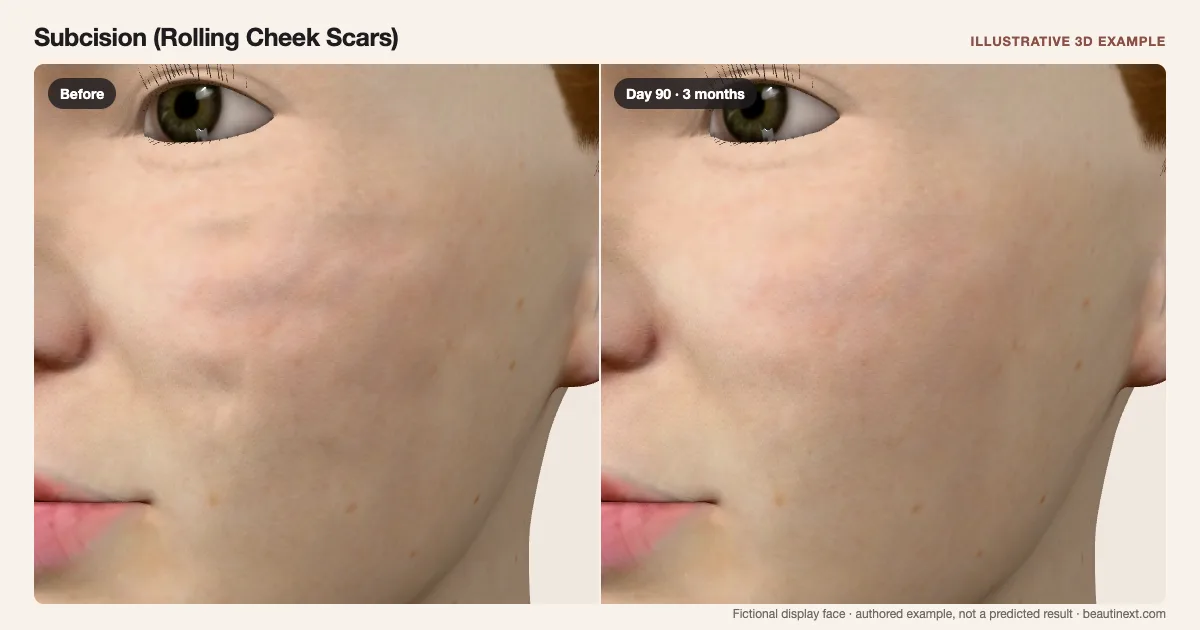
Compare fixed rolling cheek scars, early bruising and a later example with shallower but still visible depressions.
SUMMARY
What this example shows
Subcision releases tissue tethering a depressed scar. This fictional cheek pattern stays fixed while temporary swelling and bruising fade and the depressions become shallower. Some indentation remains even at the strongest example setting. It does not represent ice-pick scars, added filler, a treatment count or a measured improvement percentage.
STAGE BY STAGE
Subcision (Rolling Cheek Scars) recovery stages
Depressed-scar reference
Soft-edged depressions occupy the same cheek locations in every stage.
This authored pattern illustrates rolling scars; it is not inferred from the selected face or skin tone.
First few days: Fullness masks the texture
Temporary bruising and swelling surround the scar pattern.
Early fullness can make a contour comparison misleading. This stage is an illustration, not a recovery deadline.
Around 2 weeks: Texture emerging again
Less temporary color exposes the remaining depressions.
Individual reactions and technique differ; a quiet surface does not establish the final result.
Around 3 months: Later scar comparison
The fixed depressions are shallower, with residual texture.
The amount shown is adjustable and does not forecast improvement from one session.
TIMELINE
Day-by-day checkpoints in the 3D model
The simulator interpolates between these authored checkpoints. They describe the illustration, not measured clinical averages.
The unchanged display face provides a reference for this example.
Temporary swelling overlaps the released-scar example.
Early color and fullness obscure the scar contour.
The same scar locations remain beneath less swelling.
Less temporary color reveals residual depressions.
The example scars remain visible after early recovery.
Residual texture remains; this is not a predicted outcome.
Further treatment and individual response require assessment.
INDIVIDUAL DIFFERENCES
How recovery can vary
Timing and response
Scar type, tethering, treatment extent and healing affect the response. This example shows rolling cheek scars; raised, ice-pick and other scars need separate assessment.
Longer term
Repeat or combined treatment may be needed. The preview does not predict pigment changes, complications, complete removal or the number of sessions.
EVIDENCE NOTES
Sources and limitations
- DermNet: Subcision
Release of tethered depressed scars, bruising, variable response and possible repeat treatment. The displayed dates and depth changes are authored examples.
- AAD: Acne scar treatment
Scar types need different approaches. Scar surgery can lift depressed skin, with further change during healing and individualized combination treatment.
KEEP COMPARING
Other skin & scars examples
- Z-Plasty (Scar Reorientation)
- Scar Revision Surgery
- Mole Removal (Shave)
- Mole Removal (Excision)
- Microdermabrasion
- Dermabrasion
- Light Chemical Peel
- Medium Chemical Peel
- Deep Chemical Peel
- Ablative Laser Resurfacing
- Nonablative Laser Resurfacing
- Microneedling (Without RF)
- Radiofrequency Microneedling
- IPL (Brown-Spot Response)
- Laser Toning (Melasma)
- Skin Booster Injections
- TCA CROSS (Ice-Pick Scars)
- Punch Elevation (Boxcar Scars)
- Punch Skin Grafting (Acne Scars)
- Punch Excision (Acne Scars)
- Cryotherapy (Small Raised Scars)
- Keloid Excision
- Steroid Injections (Keloid)
- Steroid Injections (Raised Acne Scars)
- Pulsed Dye Laser (Cheek Redness)
This illustration is not medical advice, diagnosis, a treatment recommendation or a prediction of personal results. Swelling, color, contour and dates are authored examples on a fictional face. BeautiNext is not a clinic; your treating team’s assessment and written recovery plan take priority.