
SKIN & SCARS · ILLUSTRATED 3D RECOVERY
Z-Plasty (Scar Reorientation): before & after and recovery stages
Compare a linear scar with an angled closure and its later residual pattern.
SUMMARY
What this example shows
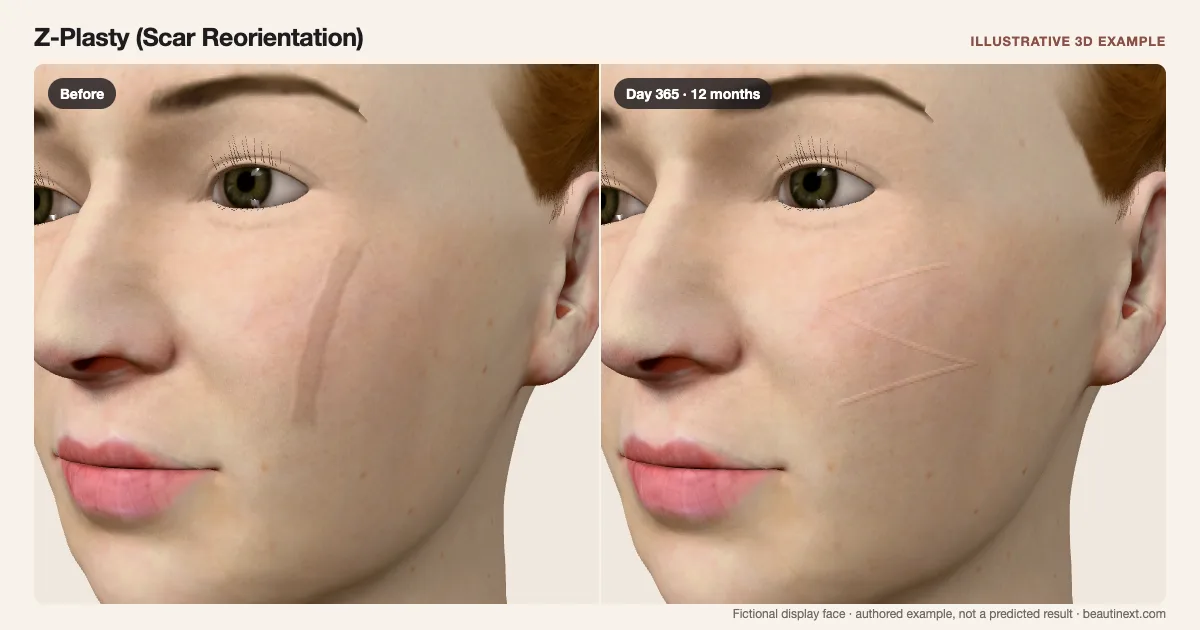
A fixed linear cheek scar changes to an angled closed scar pattern, with early stitches and local color followed by a fainter residual line. Z-plasty rearranges neighboring skin to alter scar direction. This surface example shows one authored closure pattern; flap transposition, tension release, mobility and personal incision planning are not reconstructed.
STAGE BY STAGE
Z-Plasty (Scar Reorientation) recovery stages
Linear scar reference
The same fictional healed cheek line starts every comparison.
It is a surface reference, not a diagnosis of scar tightness.
First few days: Angled closure with stitches
Crossing stitches follow a changed, closed scar pattern with local redness.
The view shows a closure example, not the flap operation or open wounds.
Around 1 month: Reoriented residual line
The angled line remains while stitches are hidden and early fullness eases.
Stitch hiding from day 14 is a display choice, not a removal schedule.
Around 1 year: Fainter angled scar
The same changed pattern remains with less color.
This is not a scar-free result or an individual completion date.
TIMELINE
Day-by-day checkpoints in the 3D model
The simulator interpolates between these authored checkpoints. They describe the illustration, not measured clinical averages.
The same fictional healed cheek line starts every comparison.
The reoriented closed line has early local color and small crossing stitches.
The changed scar pattern stays beneath temporary local fullness and redness.
The angled pattern remains as the local surface response begins to ease.
Stitches are hidden by the display, not on a personal removal schedule.
The new direction remains after the visible stitches and early fullness ease.
Color fades along the same reoriented line.
The angled residual scar remains visible.
A faint reoriented scar remains; further scar change is not predicted.
INDIVIDUAL DIFFERENCES
How recovery can vary
Timing and response
One authored surface example of Z-plasty. Scar placement and closure patterns vary; flap movement, tissue lengthening, tension release and mobility are not measured.
Longer term
Residual scarring remains and may continue changing. The preview does not predict recurrence or personal function.
EVIDENCE NOTES
Sources and limitations
- ASPS: Z-plasty and flap closure
Advanced flap closures can change scar alignment and improve flexibility. This does not calibrate the illustrated pattern or tension release.
- ASPS: Recovery after scar revision
Early local swelling and color settle before slower scar refinement over months. Dates and stitch hiding in this viewer are authored comparison points.
- NHS: Scars and longer-term fading
Scars remain and can keep changing over a prolonged period. A year in this viewer is not a guaranteed end of healing.
KEEP COMPARING
Other skin & scars examples
- Scar Revision Surgery
- Mole Removal (Shave)
- Mole Removal (Excision)
- Microdermabrasion
- Dermabrasion
- Light Chemical Peel
- Medium Chemical Peel
- Deep Chemical Peel
- Ablative Laser Resurfacing
- Nonablative Laser Resurfacing
- Microneedling (Without RF)
- Radiofrequency Microneedling
- IPL (Brown-Spot Response)
- Laser Toning (Melasma)
- Skin Booster Injections
- TCA CROSS (Ice-Pick Scars)
- Punch Elevation (Boxcar Scars)
- Punch Skin Grafting (Acne Scars)
- Punch Excision (Acne Scars)
- Cryotherapy (Small Raised Scars)
- Keloid Excision
- Steroid Injections (Keloid)
- Steroid Injections (Raised Acne Scars)
- Subcision (Rolling Cheek Scars)
- Pulsed Dye Laser (Cheek Redness)
This illustration is not medical advice, diagnosis, a treatment recommendation or a prediction of personal results. Swelling, color, contour and dates are authored examples on a fictional face. BeautiNext is not a clinic; your treating team’s assessment and written recovery plan take priority.