
SKIN & SCARS · ILLUSTRATED 3D RECOVERY
Keloid Excision: before & after and recovery stages
Compare a raised cheek keloid, its closed excision scar and one possible course with renewed growth.
SUMMARY
What this example shows
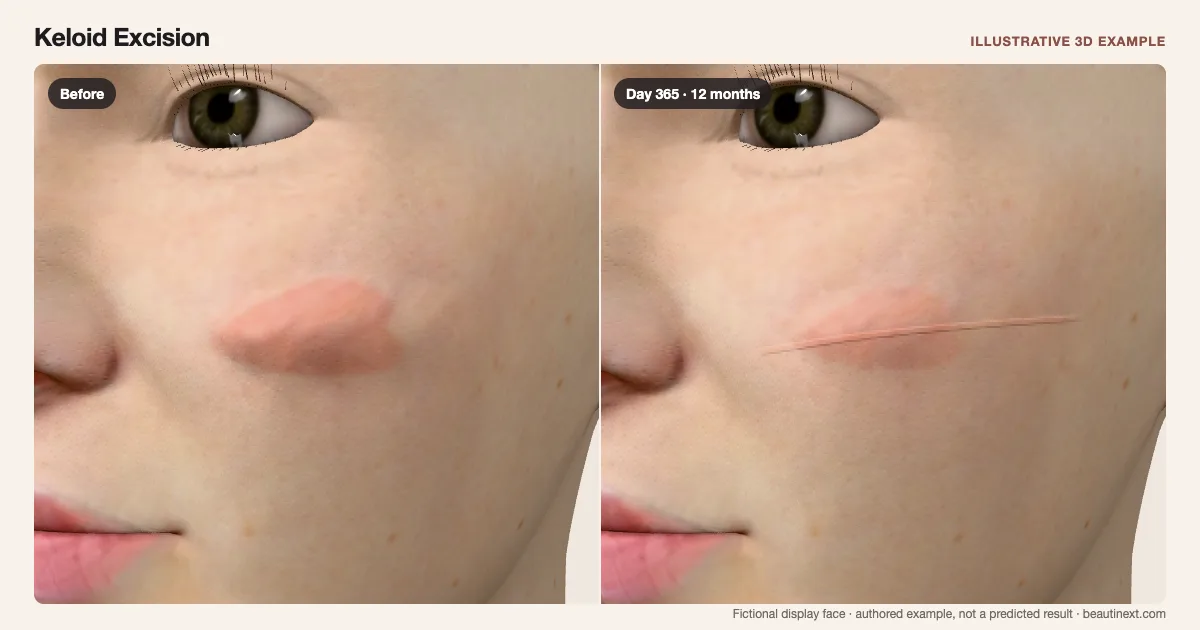
One fictional raised cheek keloid is removed and replaced by a closed line with early stitches. Local swelling and color settle. This example then shows possible renewed growth around the scar; the displayed dates and size do not predict recurrence. Surgery is often combined with other treatments. Pressure, injections, silicone, laser or radiotherapy schedules and their effects are not calculated.
STAGE BY STAGE
Keloid Excision recovery stages
Raised keloid reference
The same fictional raised cheek scar is used before excision.
The reference is not a diagnosis or an individual surgical plan.
Early closure: Closed line and stitches
The raised mark is replaced by a line with temporary local fullness and color.
Sutures and dates are illustrative; actual closure and removal timing vary.
Flatter interval: Residual closed scar
The initial reaction has eased and a line remains.
A flatter early scar does not establish lasting clearance.
Possible later course: Possible renewed growth
Raised tissue appears again around the same scar in this scenario.
This is a possible course, not a predicted recurrence date, size or likelihood.
TIMELINE
Day-by-day checkpoints in the 3D model
The simulator interpolates between these authored checkpoints. They describe the illustration, not measured clinical averages.
The unchanged display face provides a reference for this example.
A closed line and stitches replace the raised reference, with local swelling and color.
Local swelling settles while the closure remains. Stitch timing is illustrative.
The stitches are hidden and a visible closed scar remains.
Early fullness has eased; the scar line is still visible.
This authored scenario starts to show raised tissue again, not an expected recurrence date.
Raised tissue is visible around the same scar in this possible course.
A raised scar remains. Its timing and size are illustrative, not a recurrence probability or forecast.
INDIVIDUAL DIFFERENCES
How recovery can vary
Timing and response
The dates, closure and regrowth are authored comparisons. The selected face and skin tone do not determine recurrence risk.
Longer term
Surgery is often combined with other treatments. This viewer does not calculate the effects or schedules of injections, pressure, silicone, laser or radiotherapy.
EVIDENCE NOTES
Sources and limitations
- AAD: Keloid surgery and recurrence
Excision removes the keloid, but regrowth is possible and treatment is commonly combined. It does not establish this example’s recurrence date, size or individual likelihood.
- NHS: Keloids and residual scars
Keloids extend beyond the original wound and treatment aims to improve a remaining scar. The fictional cheek shape is not a diagnosis.
KEEP COMPARING
Other skin & scars examples
- Z-Plasty (Scar Reorientation)
- Scar Revision Surgery
- Mole Removal (Shave)
- Mole Removal (Excision)
- Microdermabrasion
- Dermabrasion
- Light Chemical Peel
- Medium Chemical Peel
- Deep Chemical Peel
- Ablative Laser Resurfacing
- Nonablative Laser Resurfacing
- Microneedling (Without RF)
- Radiofrequency Microneedling
- IPL (Brown-Spot Response)
- Laser Toning (Melasma)
- Skin Booster Injections
- TCA CROSS (Ice-Pick Scars)
- Punch Elevation (Boxcar Scars)
- Punch Skin Grafting (Acne Scars)
- Punch Excision (Acne Scars)
- Cryotherapy (Small Raised Scars)
- Steroid Injections (Keloid)
- Steroid Injections (Raised Acne Scars)
- Subcision (Rolling Cheek Scars)
- Pulsed Dye Laser (Cheek Redness)
This illustration is not medical advice, diagnosis, a treatment recommendation or a prediction of personal results. Swelling, color, contour and dates are authored examples on a fictional face. BeautiNext is not a clinic; your treating team’s assessment and written recovery plan take priority.