
SKIN & SCARS · ILLUSTRATED 3D RECOVERY
Light Chemical Peel: before & after and recovery stages
Compare the same starting texture through fine scaling and a subtle later smoothing example.
Also called superficial chemical peel
SUMMARY
What this example shows
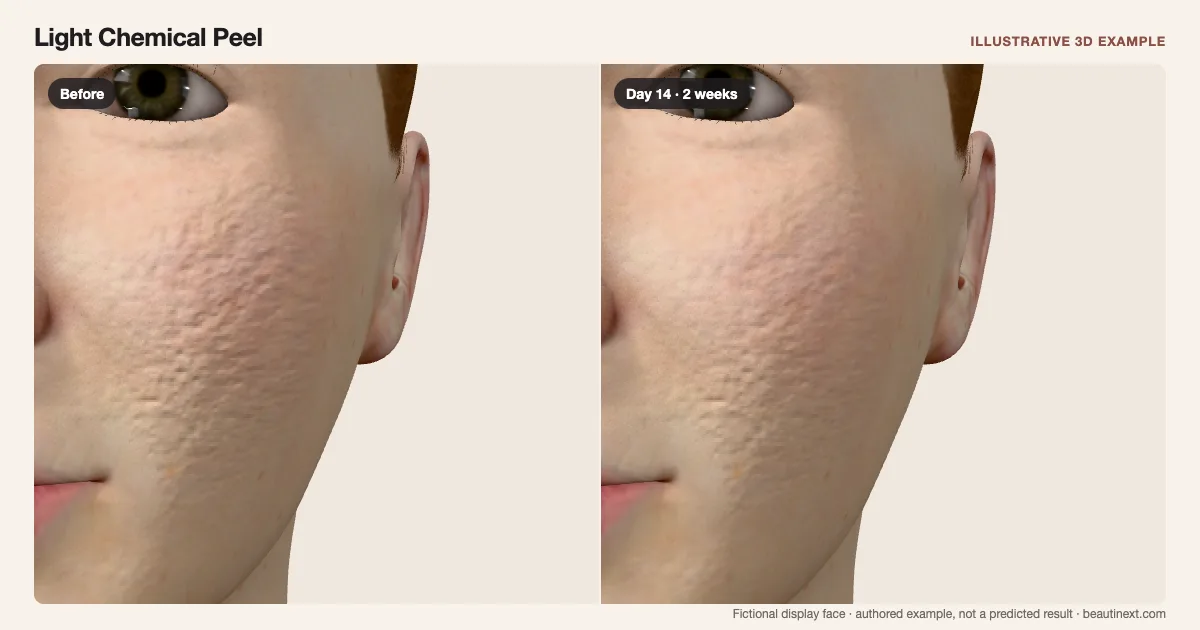
Mild color, dryness and fine scaling overlap the same starting texture. As the temporary response settles, coarse texture and fine lines become slightly softer while natural pores and facial contour remain. Dates and strength are illustrative, not a measured benefit, acid concentration or repeat-session plan.
STAGE BY STAGE
Light Chemical Peel recovery stages
Starting texture
Fixed fictional coarse texture and fine lines provide the reference.
The starting texture is illustrative, not a diagnosis or measured skin damage.
Around day 3: Fine scaling
Small dry fragments overlap the original skin detail.
Scaling may follow redness; not every light peel visibly sheds.
Around 1 week: Texture under fading flakes
Less scaling reveals a small difference in the same texture.
Surface healing varies, and residual irritation may obscure the result.
Around 2 weeks: Subtle texture change
The coarse texture and fine lines are slightly softer; natural pores remain.
Light-peel results can be subtle and may build with repeated treatments. The displayed degree and date are examples.
TIMELINE
Day-by-day checkpoints in the 3D model
The simulator interpolates between these authored checkpoints. They describe the illustration, not measured clinical averages.
Fixed fictional coarse texture and fine lines provide the reference.
The treated facial skin shows a mild temporary response.
Small dry patches become visible in the example.
Most illustrated surface flakes have faded.
The same coarse texture and fine lines are slightly softer as temporary scaling settles.
Residual fine lines and natural pores remain. The endpoint does not predict lasting benefit or pigment correction.
INDIVIDUAL DIFFERENCES
How recovery can vary
Timing and response
Agent, depth and skin response affect appearance. Selecting a display skin tone does not establish suitability or predict pigment changes.
Longer term
Residual texture remains. The display does not prescribe a series or forecast lasting benefit, scar correction or pigmentation; later aging is not animated.
EVIDENCE NOTES
Sources and limitations
- AAD: Chemical peels: FAQs
Different healing ranges for light, medium and deep peels; scaling and dressings.
- Mayo Clinic: Chemical peel
Depth-dependent surface recovery and later texture changes: subtle after light peels, more apparent after deeper peels, with possible lingering color. Exact display strengths and dates are not measured outcomes.
KEEP COMPARING
Other skin & scars examples
- Z-Plasty (Scar Reorientation)
- Scar Revision Surgery
- Mole Removal (Shave)
- Mole Removal (Excision)
- Microdermabrasion
- Dermabrasion
- Medium Chemical Peel
- Deep Chemical Peel
- Ablative Laser Resurfacing
- Nonablative Laser Resurfacing
- Microneedling (Without RF)
- Radiofrequency Microneedling
- IPL (Brown-Spot Response)
- Laser Toning (Melasma)
- Skin Booster Injections
- TCA CROSS (Ice-Pick Scars)
- Punch Elevation (Boxcar Scars)
- Punch Skin Grafting (Acne Scars)
- Punch Excision (Acne Scars)
- Cryotherapy (Small Raised Scars)
- Keloid Excision
- Steroid Injections (Keloid)
- Steroid Injections (Raised Acne Scars)
- Subcision (Rolling Cheek Scars)
- Pulsed Dye Laser (Cheek Redness)
This illustration is not medical advice, diagnosis, a treatment recommendation or a prediction of personal results. Swelling, color, contour and dates are authored examples on a fictional face. BeautiNext is not a clinic; your treating team’s assessment and written recovery plan take priority.